Datasheet4U Logo Datasheet4U.com

AS1107 - (AS1106 / AS1107) 8-Digit LED Display Drivers

Download the AS1107 datasheet PDF. This datasheet also covers the AS1106 variant, as both devices belong to the same (as1106 / as1107) 8-digit led display drivers family and are provided as variant models within a single manufacturer datasheet.

General Description

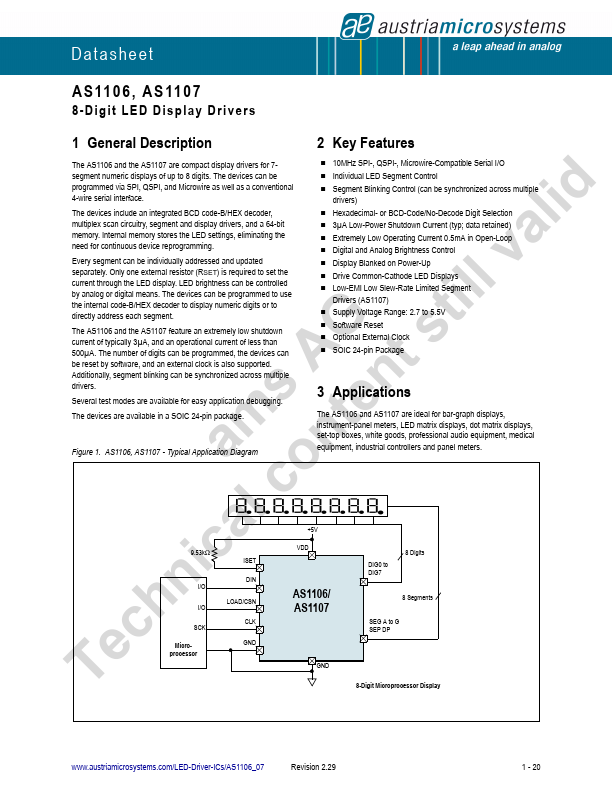
The AS1106 and the AS1107 are compact display drivers for 7segment numeric displays of up to 8 digits.

The devices can be programmed via SPI, QSPI, and Microwire as well as a conventional 4-wire serial interface.

Key Features

  • 10MHz SPI-, QSPI-, Microwire-Compatible Serial I/O Individual LED Segment Control Segment Blinking Control (can be synchronized across multiple drivers) Hexadecimal- or BCD-Code/No-Decode Digit Selection 3µA Low-Power Shutdown Current (typ; data retained) Extremely Low Operating Current 0.5mA in Open-Loop Digital and Analog Brightness Control Display Blanked on Power-Up Drive Common-Cathode LED Displays Low-EMI Low Slew-Rate Limited Segment Drivers (AS1107) Supply Voltage Range: 2.7 to 5.5V Soft.

📥 Download Datasheet

Note: The manufacturer provides a single datasheet file (AS1106_AMSCO.pdf) that lists specifications for multiple related part numbers.

Datasheet Details

Part number AS1107
Manufacturer AMSCO
File Size 1.12 MB
Description (AS1106 / AS1107) 8-Digit LED Display Drivers
Datasheet download datasheet AS1107 Datasheet

Full PDF Text Transcription (Reference)

The following content is an automatically extracted verbatim text from the original manufacturer datasheet and is provided for reference purposes only.

View original datasheet text
Technical coantmesntAsGtill valid Datasheet AS1106, AS1107 8-Digit LED Display Drivers 1 General Description The AS1106 and the AS1107 are compact display drivers for 7segment numeric displays of up to 8 digits. The devices can be programmed via SPI, QSPI, and Microwire as well as a conventional 4-wire serial interface. The devices include an integrated BCD code-B/HEX decoder, multiplex scan circuitry, segment and display drivers, and a 64-bit memory. Internal memory stores the LED settings, eliminating the need for continuous device reprogramming. Every segment can be individually addressed and updated separately. Only one external resistor (RSET) is required to set the current through the LED display. LED brightness can be controlled by analog or digital means.