
Datasheet Details
| Part number | HCPL7510 |
|---|---|
| Manufacturer | Agilent Technologies |
| File Size | 163.84 KB |
| Description | Isolated Linear Sensing IC |
| Datasheet |
 HCPL7510 Datasheet HCPL7510 Datasheet
|
|
|

Download the HCPL7510 datasheet PDF. This datasheet also covers the HCPL-7510 variant, as both devices belong to the same isolated linear sensing ic family and are provided as variant models within a single manufacturer datasheet.
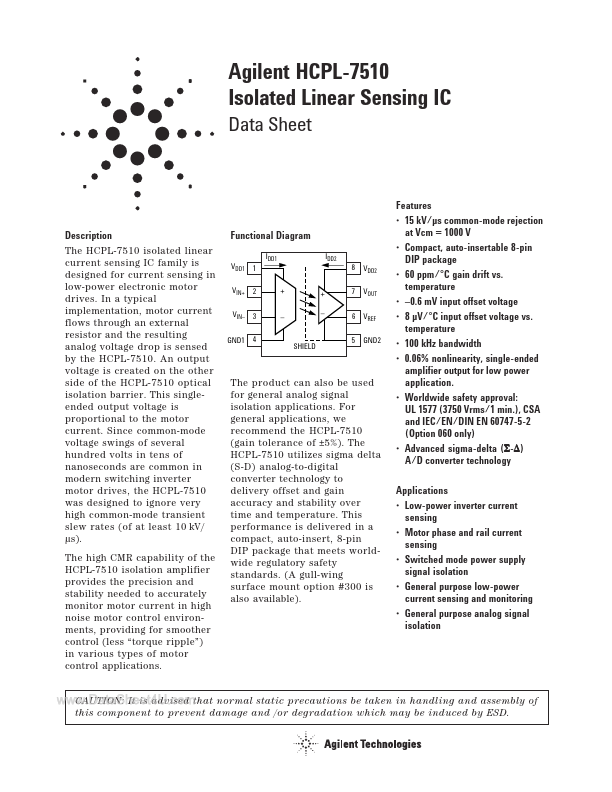
The HCPL-7510 isolated linear current sensing IC family is designed for current sensing in low-power electronic motor drives.
In a typical implementation, motor current flows through an external resistor and the resulting analog voltage drop is sensed by the HCPL-7510.
| Part number | HCPL7510 |
|---|---|
| Manufacturer | Agilent Technologies |
| File Size | 163.84 KB |
| Description | Isolated Linear Sensing IC |
| Datasheet |
HCPL7510 Datasheet
|
|
|
|
| Part Number | Description | Manufacturer |
|---|---|---|
| HCPL7710 | 40 ns Propagation Delay / CMOS Optocoupler | Hewlett-Packard |
| HCPL7860 | Optically Isolated Sigma-Delta (S-D) Modulator | Avago |
| HCPL786J | Optically Isolated Sigma-Delta (S-D) Modulator | Avago |
| HCPL-0201 | Very High CMR / Wide VCC Logic Gate Optocouplers | Hewlett-Packard |
| HCPL-0201 | Logic Gate Optocouplers | Avago |
| Part Number | Description |
|---|---|
| HCPL-0872 | Digital Interface IC |
| HCPL-4562 | High Bandwidth Analog/Video Optocouplers |
| HCPL-7510 | Isolated Linear Sensing IC |
| HCPL-T250 | 1.5 Amp Output Current IGBT Gate Drive Optocoupler |
| HCPL-T251 | 0.4AMP OUTPUT CURRENT IGBT GATE DRIVE OPTOCOUPLER |
The following content is an automatically extracted verbatim text from the original manufacturer datasheet and is provided for reference purposes only.