Datasheet4U Logo Datasheet4U.com

A80603-1 - LED Driver

Download the A80603-1 datasheet PDF. This datasheet also covers the A80603 variant, as both devices belong to the same led driver family and are provided as variant models within a single manufacturer datasheet.

General Description

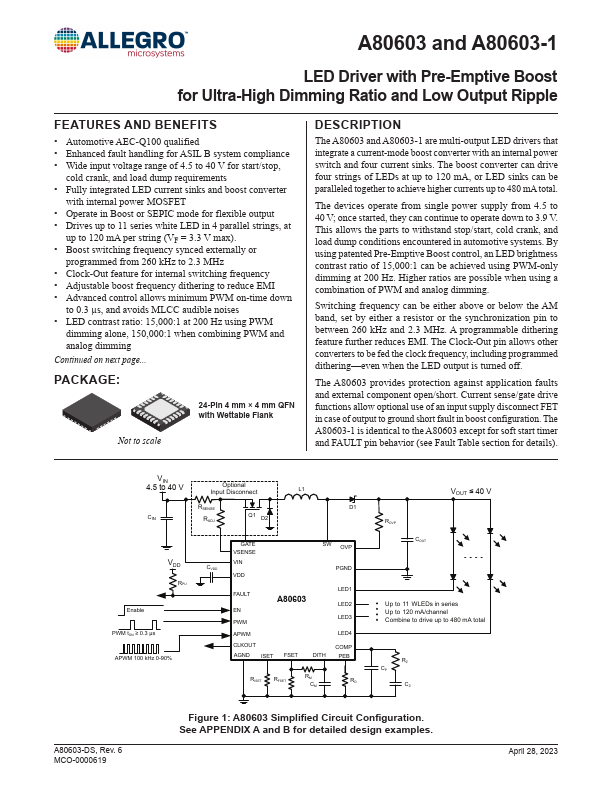
The A80603 and A80603-1 are multi-output LED drivers that integrate a current-mode boost converter with an internal power switch and four current sinks.

Key Features

  • Automotive AEC-Q100 qualified.
  • Enhanced fault handling for ASIL B system compliance.
  • Wide input voltage range of 4.5 to 40 V for start/stop, cold crank, and load dump requirements.
  • Fully integrated LED current sinks and boost converter with internal power MOSFET.
  • Operate in Boost or SEPIC mode for flexible output.
  • Drives up to 11 series white LED in 4 parallel strings, at up to 120 mA per string (VF = 3.3 V max).
  • Boost switching fr.

📥 Download Datasheet

Note: The manufacturer provides a single datasheet file (A80603-Allegro.pdf) that lists specifications for multiple related part numbers.

Full PDF Text Transcription (Reference)

The following content is an automatically extracted verbatim text from the original manufacturer datasheet and is provided for reference purposes only.

View original datasheet text
A80603 and A80603-1 LED Driver with Pre-Emptive Boost for Ultra-High Dimming Ratio and Low Output Ripple FEATURES AND BENEFITS • Automotive AEC-Q100 qualified • Enhanced fault handling for ASIL B system compliance • Wide input voltage range of 4.5 to 40 V for start/stop, cold crank, and load dump requirements • Fully integrated LED current sinks and boost converter with internal power MOSFET • Operate in Boost or SEPIC mode for flexible output • Drives up to 11 series white LED in 4 parallel strings, at up to 120 mA per string (VF = 3.3 V max). • Boost switching frequency synced externally or programmed from 260 kHz to 2.3 MHz • Clock-Out feature for internal switching frequency • Adjustable boost frequency dithering to reduce EMI • Advanced control allows minimum PWM on-time down to 0.