AD1846
AD1846 is Low Cost Parallel-Port 16-Bit SoundPort Stereo Codec manufactured by Analog Devices.
FEATURES
Low Cost, Pin- and Register-patible Alternative to AD1848 Single-Chip Integrated ∑∆ Digital Audio Stereo Codec Supports the Microsoft Windows Sound System- Multiple Channels of Stereo Input and Output Analog and Digital Signal Mixing Programmable Gain and Attenuation On-Chip Signal Filters Digital Interpolation and Decimation Analog Output Low-Pass Sample Rates from 5.5 k Hz to 48 k Hz 68-Lead PLCC Package Operation from +5 V Supply Byte-Wide Parallel Interface to ISA and EISA Buses Supports One or Two DMA Channels and Programmed I/O PRODUCT OVERVIEW
Low Cost Parallel-Port 16-Bit Sound Port Stereo Codec AD1846
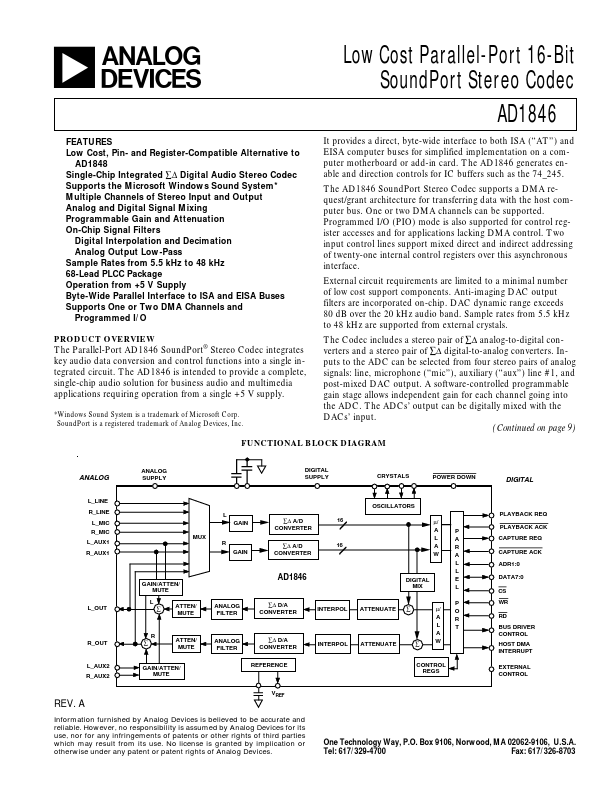
It provides a direct, byte-wide interface to both ISA (“AT”) and EISA puter buses for simplified implementation on a puter motherboard or add-in card. The AD1846 generates enable and direction controls for IC buffers such as the 74_245. The AD1846 Sound Port Stereo Codec supports a DMA request/grant architecture for transferring data with the host puter bus. One or two DMA channels can be supported. Programmed I/O (PIO) mode is also supported for control register accesses and for applications lacking DMA control. Two input control lines support mixed direct and indirect addressing of twenty-one internal control registers over this asynchronous interface. External circuit requirements are limited to a minimal number of low cost support ponents. Anti-imaging DAC output filters are incorporated on-chip. DAC dynamic range exceeds 80 d B over the 20 k Hz audio band. Sample rates from 5.5 k Hz to 48 k Hz are supported from external crystals. The Codec includes a stereo pair of ∑∆ analog-to-digital converters and a stereo pair of ∑∆ digital-to-analog converters. Inputs to the ADC can be selected from four stereo pairs of analog signals: line, microphone (“mic”), auxiliary (“aux”) line #1, and post-mixed DAC output. A software-controlled programmable gain stage allows independent gain for each channel going into the ADC. The ADCs’ output can be digitally mixed with...