• Part: AD1856
  • Description: 16-Bit PCM Audio DAC
  • Manufacturer: Analog Devices
  • Size: 281.41 KB
Download AD1856 Datasheet PDF
Analog Devices
AD1856
AD1856 is 16-Bit PCM Audio DAC manufactured by Analog Devices.
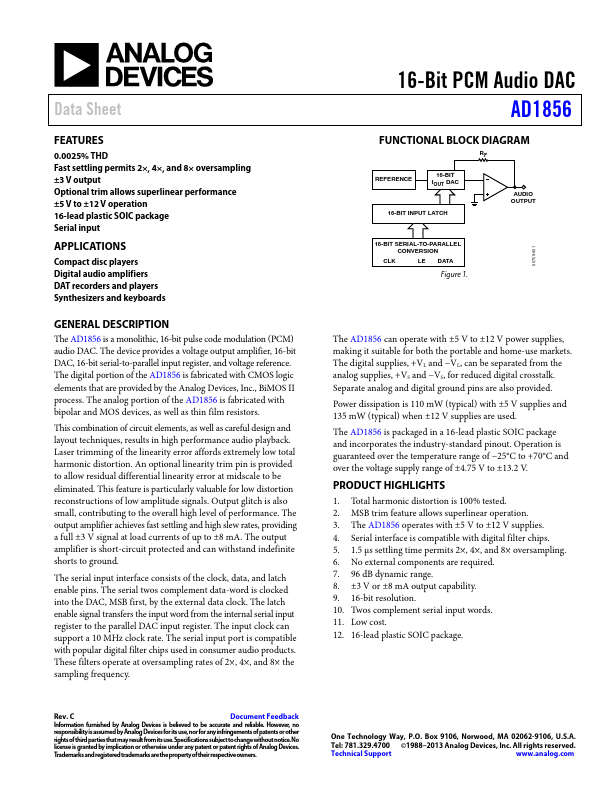
FEATURES 0.0025% THD Fast settling permits 2×, 4×, and 8× oversampling ±3 V output Optional trim allows superlinear performance ±5 V to ±12 V operation 16-lead plastic SOIC package Serial input APPLICATIONS pact disc players Digital audio amplifiers DAT recorders and players Synthesizers and keyboards GENERAL DESCRIPTION The AD1856 is a monolithic, 16-bit pulse code modulation (PCM) audio DAC. The device provides a voltage output amplifier, 16-bit DAC, 16-bit serial-to-parallel input register, and voltage reference. The digital portion of the AD1856 is fabricated with CMOS logic elements that are provided by the Analog Devices, Inc., Bi MOS II process. The analog portion of the AD1856 is fabricated with bipolar and MOS devices, as well as thin film resistors. This bination of circuit elements, as well as careful design and layout techniques, results in high performance audio playback. Laser trimming of the linearity error affords extremely low total harmonic distortion. An optional linearity trim pin is provided to allow residual differential linearity error at midscale to be eliminated. This feature is particularly valuable for low distortion reconstructions of low amplitude signals. Output glitch is also small, contributing to the overall high level of performance. The output amplifier achieves fast settling and high slew rates, providing a full ±3 V signal at load currents of up to ±8 m A. The output amplifier is short-circuit protected and can withstand indefinite shorts to ground. The serial input interface consists of the clock, data, and latch enable pins. The serial twos plement data-word is clocked into the DAC, MSB first, by the external data clock. The latch enable signal transfers the input word from the internal serial input register to the parallel DAC input register. The input clock can support a 10 MHz clock rate. The serial input port is patible with popular digital filter chips used in consumer audio products. These filters operate at oversampling...