AD6641
AD6641 is 250 MHz Bandwidth DPD Observation Receiver manufactured by Analog Devices.
FEATURES
SNR = 65.8 d BFS at f IN up to 250 MHz at 500 MSPS ENOB of 10.5 bits at f IN up to 250 MHz at 500 MSPS (- 1.0 d BFS) SFDR = 80 d Bc at f IN up to 250 MHz at 500 MSPS (- 1.0 d BFS) Excellent linearity
DNL = ±0.5 LSB typical, INL = ±0.6 LSB typical Integrated 16k × 12 FIFO FIFO readback options
12-bit parallel CMOS at 62.5 MHz 6-bit DDR LVDS interface SPORT at 62.5 MHz SPI at 25 MHz High speed synchronization capability 1 GHz full power analog bandwidth Integrated input buffer On-chip reference, no external decoupling required Low power dissipation 695 m W at 500 MSPS Programmable input voltage range 1.18 V to 1.6 V, 1.5 V nominal 1.9 V analog and digital supply operation 1.9 V or 3.3 V SPI and SPORT operation Clock duty cycle stabilizer Integrated data clock output with programmable clock and data alignment
GENERAL DESCRIPTION
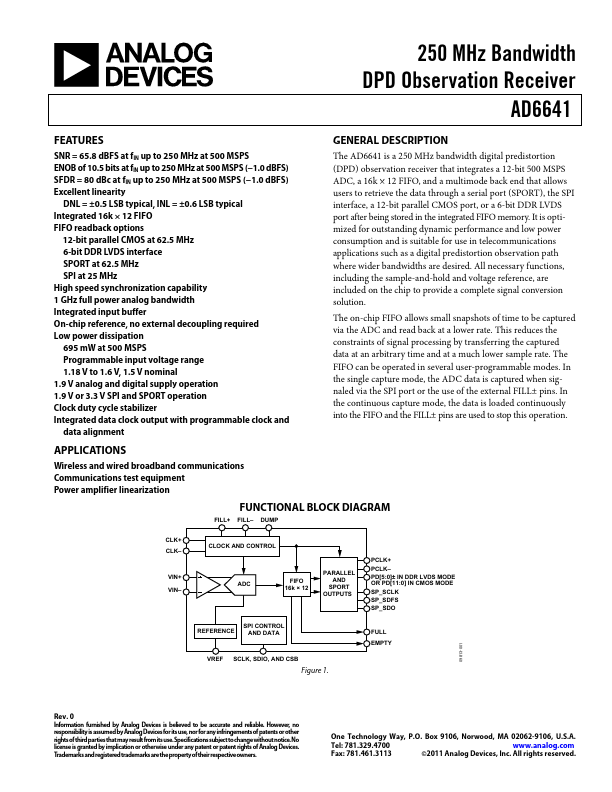
The AD6641 is a 250 MHz bandwidth digital predistortion (DPD) observation receiver that integrates a 12-bit 500 MSPS ADC, a 16k × 12 FIFO, and a multimode back end that allows users to retrieve the data through a serial port (SPORT), the SPI interface, a 12-bit parallel CMOS port, or a 6-bit DDR LVDS port after being stored in the integrated FIFO memory. It is optimized for outstanding dynamic performance and low power consumption and is suitable for use in telemunications applications such as a digital predistortion observation path where wider bandwidths are desired. All necessary functions, including the sample-and-hold and voltage reference, are included on the chip to provide a plete signal conversion solution.
The on-chip FIFO allows small snapshots of time to be captured via the ADC and read back at a lower rate. This reduces the constraints of signal processing by transferring the captured data at an arbitrary time and at a much lower sample rate. The FIFO can be operated in several user-programmable modes. In the single capture mode, the ADC data is captured when signaled via the SPI port or the use of the external FILL± pins. In the...