• Part: AD9152
  • Description: Digital-to-Analog Converter
  • Manufacturer: Analog Devices
  • Size: 2.13 MB
Download AD9152 Datasheet PDF
Analog Devices
AD9152
AD9152 is Digital-to-Analog Converter manufactured by Analog Devices.
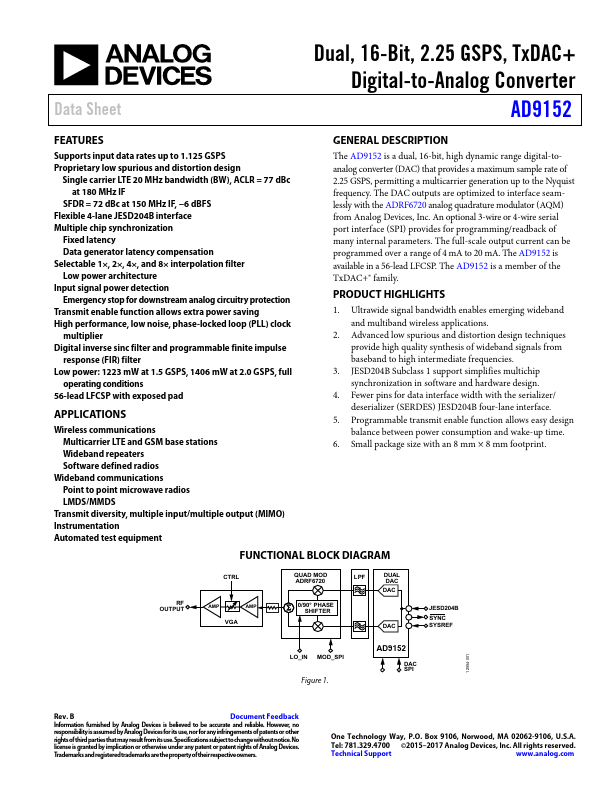
Data Sheet Dual, 16-Bit, 2.25 GSPS, Tx DAC+ Digital-to-Analog Converter AD9152 Features Supports input data rates up to 1.125 GSPS Proprietary low spurious and distortion design Single carrier LTE 20 MHz bandwidth (BW), ACLR = 77 d Bc at 180 MHz IF SFDR = 72 d Bc at 150 MHz IF, - 6 d BFS Flexible 4-lane JESD204B interface Multiple chip synchronization Fixed latency Data generator latency pensation Selectable 1×, 2×, 4×, and 8× interpolation filter Low power architecture Input signal power detection Emergency stop for downstream analog circuitry protection Transmit enable function allows extra power saving High performance, low noise, phase-locked loop (PLL) clock multiplier Digital inverse sinc filter and programmable finite impulse response (FIR) filter Low power: 1223 m W at 1.5 GSPS, 1406 m W at 2.0 GSPS, full operating conditions 56-lead LFCSP with exposed pad APPLICATIONS Wireless munications Multicarrier LTE and GSM base stations Wideband repeaters Software defined radios Wideband munications Point to point microwave radios LMDS/MMDS Transmit diversity, multiple input/multiple output (MIMO) Instrumentation Automated test equipment GENERAL DESCRIPTION The AD9152 is a dual, 16-bit, high dynamic range digital-toanalog converter (DAC) that provides a maximum sample rate of 2.25 GSPS, permitting a multicarrier generation up to the Nyquist frequency. The DAC outputs are optimized to interface seamlessly with the ADRF6720 analog quadrature modulator (AQM) from Analog Devices, Inc. An optional 3-wire or 4-wire serial port interface (SPI) provides for programming/readback of many internal parameters. The full-scale output current can be programmed over a range of 4 m A to 20 m A. The AD9152 is available in a 56-lead LFCSP. The AD9152 is a member of the Tx DAC+® family. PRODUCT HIGHLIGHTS 1. Ultrawide signal bandwidth enables emerging wideband and multiband wireless applications. 2. Advanced low spurious and distortion design techniques provide high quality...