ADBMS1818
ADBMS1818 is 18-Cell Battery Monitor manufactured by Analog Devices.
FEATURES
- Measures up to 18 battery cells in series
- 3 m V maximum total measurement error
- Stackable architecture for high voltage systems
- Built-in iso SPI interface
- 1 Mb isolated serial munications
- Uses a single twisted pair, up to 100 meters
- Low EMI susceptibility and emissions
- Bidirectional for broken wire protection
- 290 µs to measure all cells in a system
- Synchronized voltage and current measurement
- 16-bit Δ-Σ ADC with programmable third-order noise filter
- Passive cell balancing up to 200 m A (maximum) with programmable pulse‑width modulation
- 9 general-purpose digital I/O or analog inputs
- Temperature or other sensor inputs
- Configurable as an I2C or SPI master
- 6 µA sleep mode supply current
- 64-lead LQFP_EP package
APPLICATIONS
- Backup battery systems
- Grid energy storage
- Residential energy storage
- UPS
- High power portable equipment
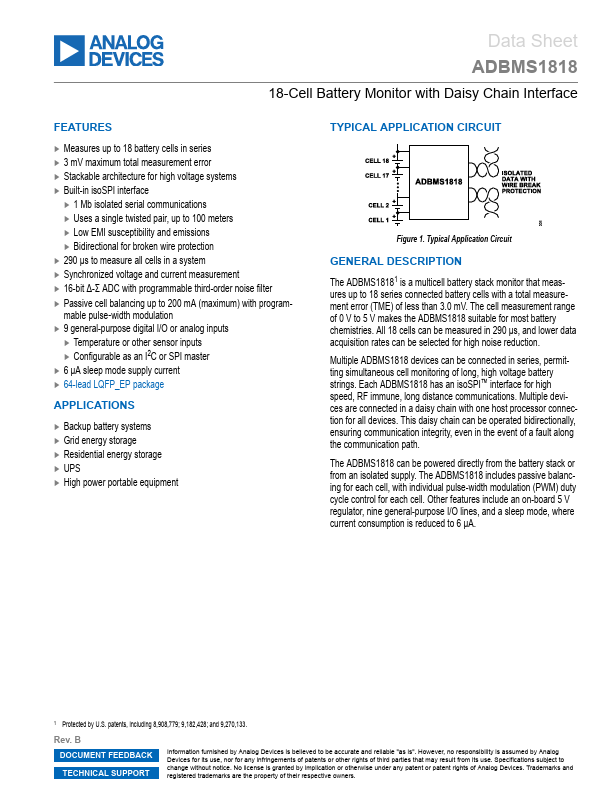
TYPICAL APPLICATION CIRCUIT
Figure 1. Typical Application Circuit
GENERAL DESCRIPTION
The ADBMS18181 is a multicell battery stack monitor that measures up to 18 series connected battery cells with a total measurement error (TME) of less than 3.0 m V. The cell measurement range of 0 V to 5 V makes the ADBMS1818 suitable for most battery chemistries. All 18 cells can be measured in 290 µs, and lower data acquisition rates can be selected for high noise reduction. Multiple ADBMS1818 devices can be connected in series, permitting simultaneous cell monitoring of long, high voltage battery strings. Each ADBMS1818 has an iso SPI™ interface for high speed, RF immune, long distance munications. Multiple devices are connected in a daisy chain with one host processor connection for all devices. This daisy chain can be operated bidirectionally, ensuring munication integrity, even in the event of a fault along the munication path. The ADBMS1818 can be powered directly from the battery stack or from an isolated supply. The ADBMS1818 includes passive balancing for each cell, with individual pulse-width modulation...