ADD5203
ADD5203 is White LED Driver with SMBus and PWM Input manufactured by Analog Devices.
FEATURES
White LED driver based on inductive boost converter Integrated 50 V MOSFET with 2.9 A peak current limit Input voltage range: 6 V to 21 V Maximum output adjustable up to 45 V 350 k Hz to 1 MHz adjustable operating frequency Overvoltage protection (OVP) up to typical 47.5 V Built-in soft start for boost converter Drives up to eight LED current strings LED current adjustable up to 30 m A for each channel Headroom control to maximize efficiency Adjustable dimming frequency: 200 Hz to 10 k Hz LED open and short fault protection Selectable dimming control interface methods PWM input SMBus serial input Selectable dimming modes Fixed delay PWM dimming control with 8-bit resolution No delay PWM dimming control with 8-bit resolution Direct PWM dimming control DC current dimming control with 8-bit resolution General Thermal shutdown Undervoltage lockout 28-lead, 4 mm × 4 mm × 0.75 mm LFCSP_WQ
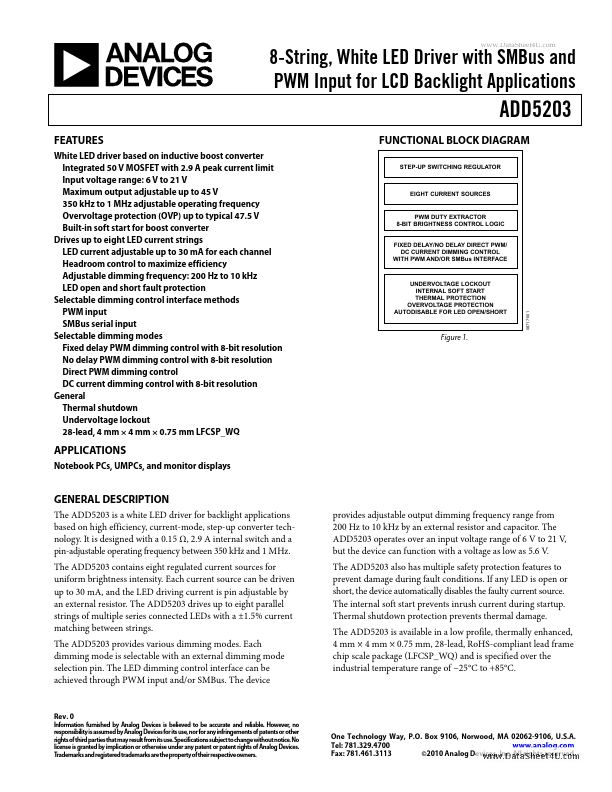
FUNCTIONAL BLOCK DIAGRAM
STEP-UP SWITCHING REGULATOR
EIGHT CURRENT SOURCES
PWM DUTY EXTRACTOR 8-BIT BRIGHTNESS CONTROL LOGIC FIXED DELAY/NO DELAY DIRECT PWM/ DC CURRENT DIMMING CONTROL WITH PWM AND/OR SMBus INTERFACE
Figure 1.
APPLICATIONS
Notebook PCs, UMPCs, and monitor displays
GENERAL DESCRIPTION
The ADD5203 is a white LED driver for backlight applications based on high efficiency, current-mode, step-up converter technology. It is designed with a 0.15 Ω, 2.9 A internal switch and a pin-adjustable operating frequency between 350 k Hz and 1 MHz. The ADD5203 contains eight regulated current sources for uniform brightness intensity. Each current source can be driven up to 30 m A, and the LED driving current is pin adjustable by an external resistor. The ADD5203 drives up to eight parallel strings of multiple series connected LEDs with a ±1.5% current matching between strings. The ADD5203 provides various dimming modes. Each dimming mode is selectable with an external dimming mode selection pin. The LED dimming control interface can be achieved through PWM input and/or SMBus....