• Part: ADGM1121
  • Description: MEMS Switch
  • Manufacturer: Analog Devices
  • Size: 6.20 MB
Download ADGM1121 Datasheet PDF
Analog Devices
ADGM1121
ADGM1121 is MEMS Switch manufactured by Analog Devices.
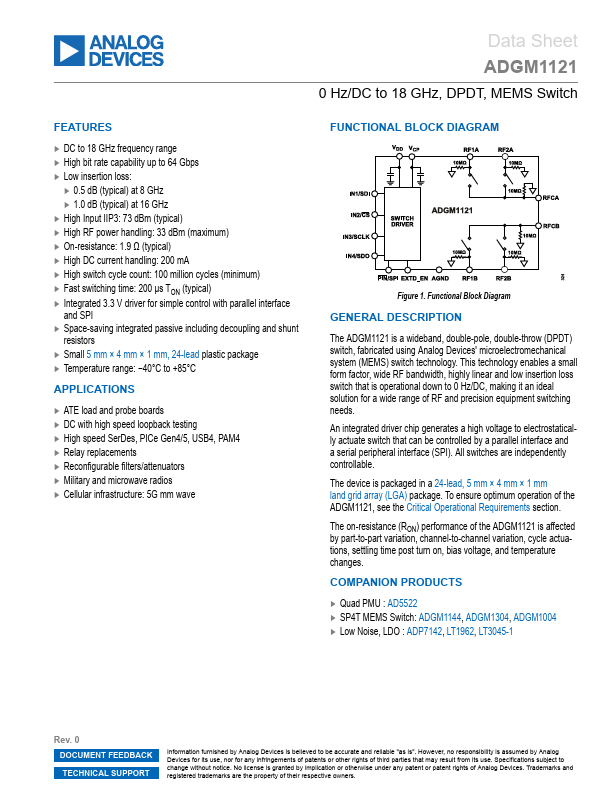
FEATURES - DC to 18 GHz frequency range - High bit rate capability up to 64 Gbps - Low insertion loss: - 0.5 d B (typical) at 8 GHz - 1.0 d B (typical) at 16 GHz - High Input IIP3: 73 d Bm (typical) - High RF power handling: 33 d Bm (maximum) - On-resistance: 1.9 Ω (typical) - High DC current handling: 200 m A - High switch cycle count: 100 million cycles (minimum) - Fast switching time: 200 µs TON (typical) - Integrated 3.3 V driver for simple control with parallel interface and SPI - Space-saving integrated passive including decoupling and shunt resistors - Small 5 mm × 4 mm × 1 mm, 24-lead plastic package - Temperature range: - 40°C to +85°C APPLICATIONS - ATE load and probe boards - DC with high speed loopback testing - High speed Ser Des, PICe Gen4/5, USB4, PAM4 - Relay replacements - Reconfigurable filters/attenuators - Military and microwave radios - Cellular infrastructure: 5G mm wave FUNCTIONAL BLOCK DIAGRAM Figure 1. Functional Block Diagram GENERAL DESCRIPTION The ADGM1121 is a wideband, double-pole, double-throw (DPDT) switch, fabricated using Analog Devices' microelectromechanical system (MEMS) switch technology. This technology enables a small form factor, wide RF bandwidth, highly linear and low insertion loss switch that is operational down to 0 Hz/DC, making it an ideal solution for a wide range of RF and precision equipment switching needs. An integrated driver chip generates a high voltage to electrostatically actuate switch that can be controlled by a parallel interface and a serial peripheral interface (SPI). All switches are independently controllable. The device is packaged in a 24-lead, 5 mm × 4 mm × 1 mm land grid array (LGA) package. To ensure optimum operation of the ADGM1121, see the Critical Operational Requirements section. The on-resistance (RON) performance of the ADGM1121 is affected by part-to-part variation, channel-to-channel variation, cycle actuations, settling time post turn on, bias voltage, and temperature changes. PANION PRODUCTS...