ADL5513
ADL5513 is Logarithmic Detector/Controller manufactured by Analog Devices.
FEATURES
- Wide bandwidth: 1 MHz to 4 GHz
- 80 d B dynamic range (±3 d B)
- Constant dynamic range over frequency
- Stability over
- 40°C to +85°C temperature range: ±0.5 d B
- Operating temperature range:
- 40°C to +125°C
- Sensitivity:
- 70 d Bm
- Low noise measurement/controller output (VOUT)
- Pulse response time: 21 ns/20 ns (fall/rise)
- Single-supply operation: 2.7 V to 5.5 V at 31 m A
- Power-down feature
: 1 m W at 5 V
- Small footprint LFCSP
- Fabricated using high speed Si Ge process
APPLICATIONS
- RF transmitter power amplifier linearization and gain/power control
- Power monitoring in radio link transmitters
- RSSI measurement in base stations, WLAN, Wi MAX, RADAR
GENERAL DESCRIPTION
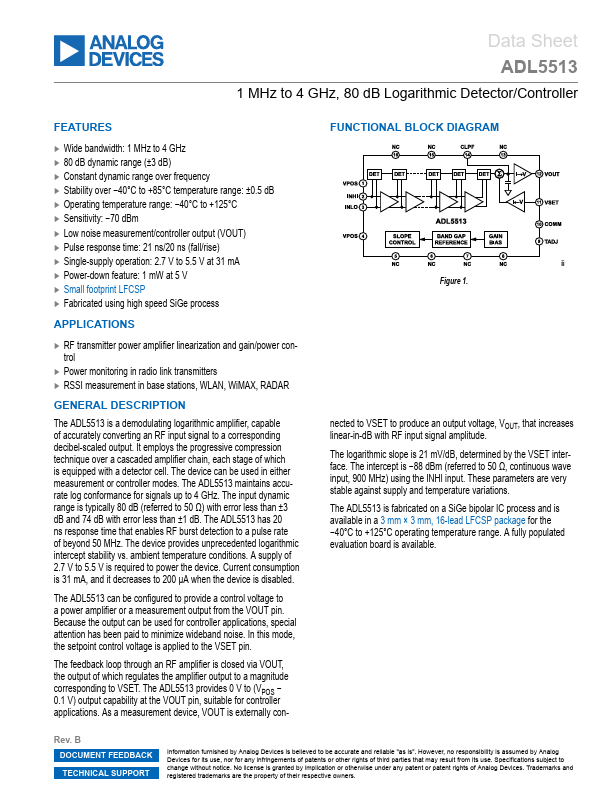
The ADL5513 is a demodulating logarithmic amplifier, capable of accurately converting an RF input signal to a corresponding decibel-scaled output. It employs the progressive pression technique over a cascaded amplifier chain, each stage of which is equipped with a detector cell. The device can be used in either measurement or controller modes. The ADL5513 maintains accurate log conformance for signals up to 4 GHz. The input dynamic range is typically 80 d B (referred to 50 Ω) with error less than ±3 d B and 74 d B with error less than ±1 d B. The ADL5513 has 20 ns response time that enables RF burst detection to a pulse rate of beyond 50 MHz. The device provides unprecedented logarithmic intercept stability vs. ambient temperature conditions. A supply of 2.7 V to 5.5 V is required to power the device. Current consumption is 31 m A, and it decreases to 200 μA when the device is disabled.
The ADL5513 can be configured to provide a control voltage to a power amplifier or a measurement output from the VOUT pin. Because the output can be used for controller applications, special attention has been paid to minimize wideband noise. In this mode, the setpoint control voltage is applied to the VSET pin.
The feedback loop through an RF amplifier is closed via VOUT, the output of which regulates the...