ADTR1107
ADTR1107 is 6-GHz to 18-GHz Front-End manufactured by Analog Devices.
Features
- Operates from 6 GHz to 18 GHz
- 25 d Bm typical transmit state PSAT
- 22 d B typical transmit state small signal gain
- 18 d B typical receive state small signal gain
- 2.5 d B typical receive state noise figure
- Coupled power amplifier output for power detection
APPLICATIONS
- Phased array antenna
- Military radar
- Weather radar
- munication links
- Electronic warfare
GENERAL DESCRIPTION
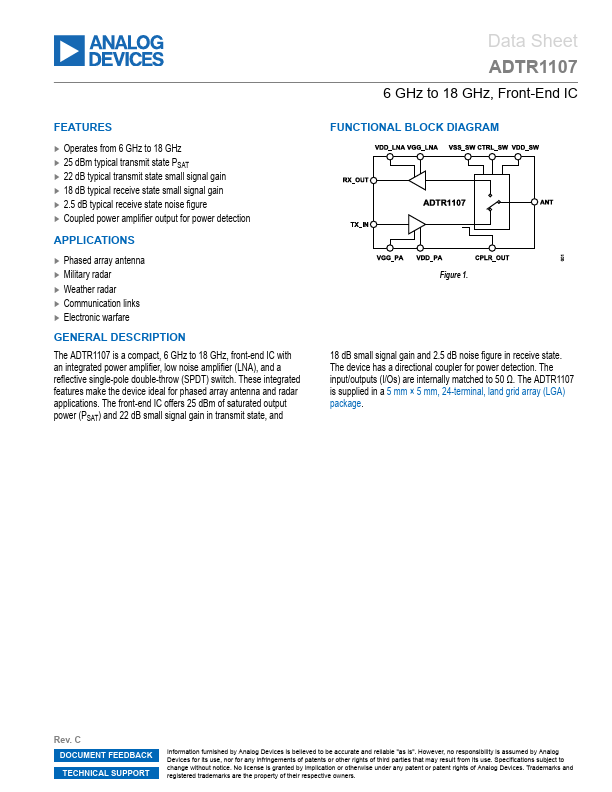
The ADTR1107 is a pact, 6 GHz to 18 GHz, front-end IC with an integrated power amplifier, low noise amplifier (LNA), and a reflective single-pole double-throw (SPDT) switch. These integrated Features make the device ideal for phased array antenna and radar applications. The front-end IC offers 25 d Bm of saturated output power (PSAT) and 22 d B small signal gain in transmit state, and
Data Sheet ADTR1107
6 GHz to 18 GHz, Front-End IC
FUNCTIONAL BLOCK DIAGRAM
Figure 1.
18 d B small signal gain and 2.5 d B noise figure in receive state. The device has a directional coupler for power detection. The input/outputs (I/Os) are internally matched to 50 Ω. The ADTR1107 is supplied in a 5 mm × 5 mm, 24-terminal, land grid array (LGA) package.
Rev. C DOCUMENT FEEDBACK TECHNICAL SUPPORT
Information furnished by Analog Devices is believed to be accurate and reliable "as is". However, no responsibility is assumed by Analog Devices for its use, nor for any infringements of patents or other rights of third parties that may result from its use. Specifications subject to change without notice. No license is granted by implication or otherwise under any patent or patent rights of Analog Devices. Trademarks and registered trademarks are the property of their respective owners.
Data Sheet
TABLE OF CONTENTS
Features
................................................................ 1 Applications........................................................... 1 Functional Block Diagram......................................1 General Description...............................................1...