LTC4287
LTC4287 is High Power Positive Hot Swap Controller manufactured by Analog Devices.
FEATURES
- Drives two gates for high power applications
- Wide input supply voltage range: 6.5 V to 80 V
- Optimizes MOSFET SOA with multimode start-up sequencing and operation
- Monitors currents, voltages, power, and energy with the ADC
- Limits MOSFET temperature for overstress protection
- Adjustable, 6.6% accurate (5 m V) current limit with foldback
- Black Box capturing and configuration using an optional external
EEPROM
- SMBus 3.1 interface and PMBus-pliant mand structure
- Parallelable controllers for high current levels
- Minimum and maximum ADC measurements logging with alerts
- Available in 48(39)-lead plastic QFN (7 mm × 7 mm) package
- Configurable current foldback
APPLICATIONS
- High availability server backplane systems
- 12 V/24 V/48 V/54 V distributed power systems
- Industrial
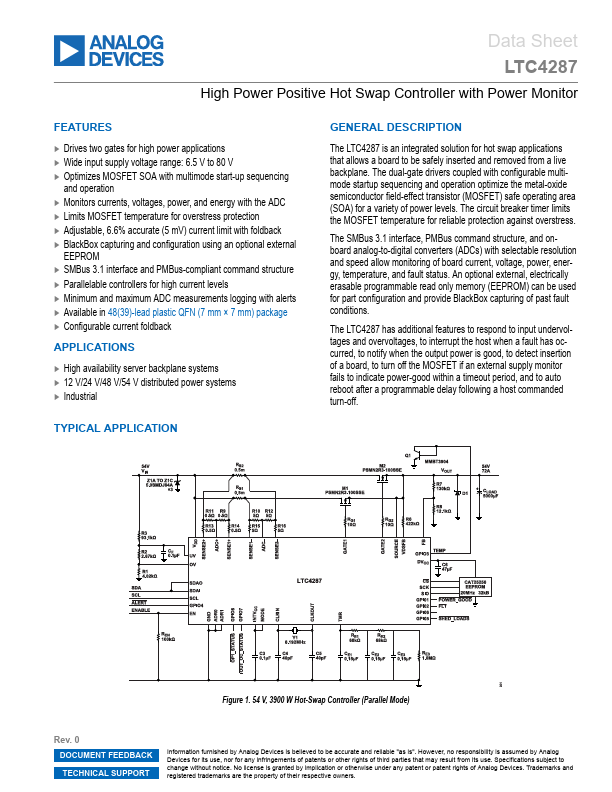
TYPICAL APPLICATION
GENERAL DESCRIPTION
The LTC4287 is an integrated solution for hot swap applications that allows a board to be safely inserted and removed from a live backplane. The dual-gate drivers coupled with configurable multimode startup sequencing and operation optimize the metal-oxide semiconductor field-effect transistor (MOSFET) safe operating area (SOA) for a variety of power levels. The circuit breaker timer limits the MOSFET temperature for reliable protection against overstress. The SMBus 3.1 interface, PMBus mand structure, and onboard analog-to-digital converters (ADCs) with selectable resolution and speed allow monitoring of board current, voltage, power, energy, temperature, and fault status. An optional external, electrically erasable programmable read only memory (EEPROM) can be used for part configuration and provide Black Box capturing of past fault conditions. The LTC4287 has additional features to respond to input undervoltages and overvoltages, to interrupt the host when a fault has occurred, to notify when the output power is good, to detect insertion of a board, to turn off the MOSFET if an external supply monitor fails to indicate power-good...