• Part: LTC7804
  • Description: Boost Controller
  • Manufacturer: Analog Devices
  • Size: 1.39 MB
Download LTC7804 Datasheet PDF
Analog Devices
LTC7804
LTC7804 is Boost Controller manufactured by Analog Devices.
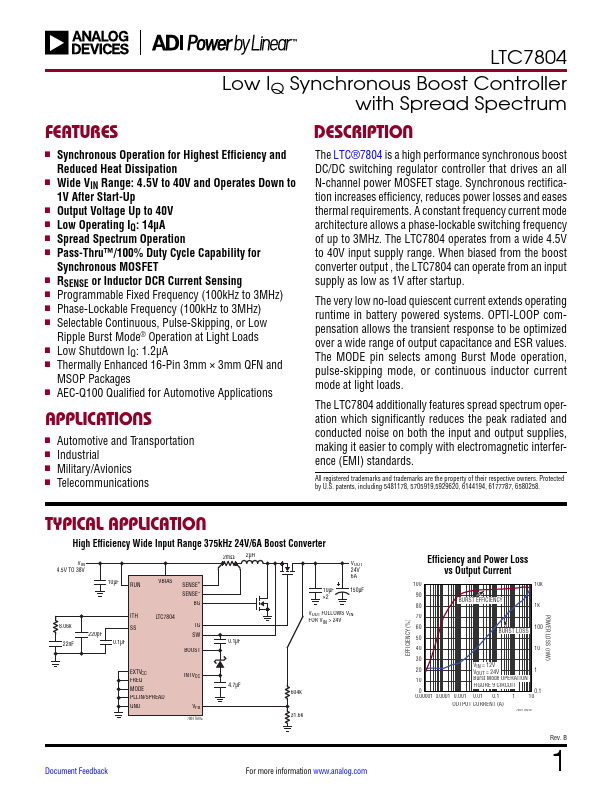
FEATURES n Synchronous Operation for Highest Efficiency and Reduced Heat Dissipation n Wide VIN Range: 4.5V to 40V and Operates Down to 1V After Start-Up n Output Voltage Up to 40V n Low Operating IQ: 14μA n Spread Spectrum Operation n Pass-Thru™/100% Duty Cycle Capability for Synchronous MOSFET n RSENSE or Inductor DCR Current Sensing n Programmable Fixed Frequency (100k Hz to 3MHz) n Phase-Lockable Frequency (100k Hz to 3MHz) n Selectable Continuous, Pulse-Skipping, or Low Ripple Burst Mode® Operation at Light Loads n Low Shutdown IQ: 1.2μA n Thermally Enhanced 16-Pin 3mm × 3mm QFN and MSOP Packages n AEC-Q100 Qualified for Automotive Applications APPLICATIONS n Automotive and Transportation n Industrial n Military/Avionics n Telemunications DESCRIPTION The LTC®7804 is a high performance synchronous boost DC/DC switching regulator controller that drives an all N-channel power MOSFET stage. Synchronous rectification increases efficiency, reduces power losses and eases thermal requirements. A constant frequency current mode architecture allows a phase-lockable switching frequency of up to 3MHz. The LTC7804 operates from a wide 4.5V to 40V input supply range. When biased from the boost converter output , the LTC7804 can operate from an input supply as low as 1V after startup. The very low no-load quiescent current extends operating runtime in battery powered systems. OPTI-LOOP pensation allows the transient response to be optimized over a wide range of output capacitance and ESR values. The MODE pin selects among Burst Mode operation, pulse-skipping mode, or continuous inductor current mode at light loads. The LTC7804 additionally features spread spectrum operation which significantly reduces the peak radiated and conducted noise on both the input and output supplies, making it easier to ply with electromagnetic interference (EMI) standards. All registered trademarks and trademarks are the property of their respective owners. Protected by U.S. patents, including...