
OP227
OP227 is Dual / Low Noise / Low Offset Instrumentation Operational Amplifier manufactured by Analog Devices.
a
Dual, Low Noise, Low Offset Instrumentation Operational Amplifier OP227
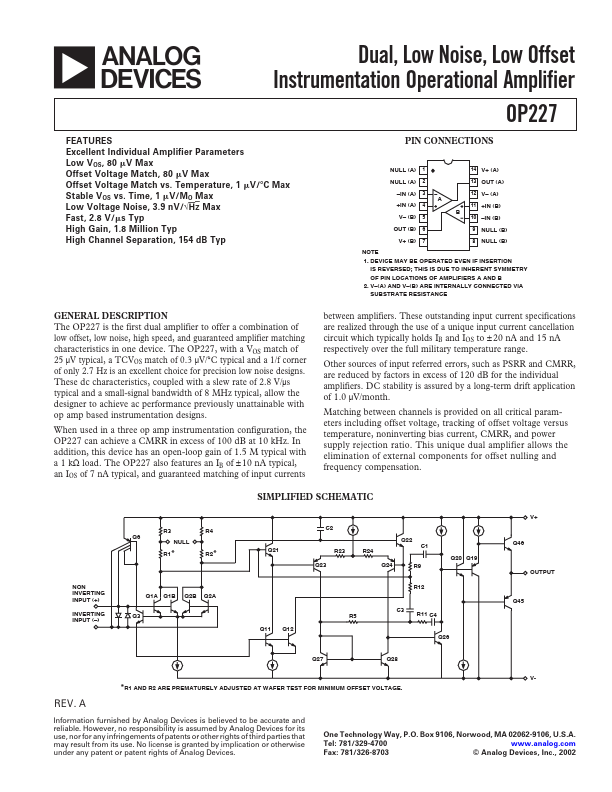
PIN CONNECTIONS
NULL (A) NULL (A)
- IN (A) +IN (A) V- (B) OUT (B) V+ (B)
1 2 3 14 13 12
Features
Excellent Individual Amplifier Parameters Low VOS, 80 V Max Offset Voltage Match, 80 V Max Offset Voltage Match vs. Temperature, 1 V/؇ C Max Stable VOS vs. Time, 1 V/M O Max Low Voltage Noise, 3.9 n V/÷Hz Max Fast, 2.8 V/ s Typ High Gain, 1.8 Million Typ High Channel Separation, 154 d B Typ
V+ (A) OUT (A) V- (A) +IN (B)
- IN (B) NULL (B) NULL (B)
4 11
5 6 7 10 9 8
NOTE 1. DEVICE MAY BE OPERATED EVEN IF INSERTION IS REVERSED; THIS IS DUE TO INHERENT SYMMETRY OF PIN LOCATIONS OF AMPLIFIERS A AND B 2. V- (A) AND V- (B) ARE INTERNALLY CONNECTED VIA SUBSTRATE RESISTANCE
GENERAL DESCRIPTION
The OP227 is the first dual amplifier to offer a bination of low offset, low noise, high speed, and guaranteed amplifier matching characteristics in one device. The OP227, with a VOS match of 25 m V typical, a TCVOS match of 0.3 m V/∞C typical and a 1/f corner of only 2.7 Hz is an excellent choice for precision low noise designs. These dc characteristics, coupled with a slew rate of 2.8 V/ms typical and a small-signal bandwidth of 8 MHz typical, allow the designer to achieve ac performance previously unattainable with op amp based instrumentation designs. When used in a three op amp instrumentation configuration, the OP227 can achieve a CMRR in excess of 100 d B at 10 k Hz. In addition, this device has an open-loop gain of 1.5 M typical with a 1 k W load. The OP227 also Features an IB of ± 10 n A typical, an IOS of 7 n A typical, and guaranteed matching of input currents between amplifiers. These outstanding input current specifications are realized through the use of a unique input current cancellation circuit which typically holds IB and IOS to ± 20 n A and 15 n A respectively over the full military temperature range. Other sources of input referred errors, such as PSRR and CMRR, are reduced by factors in...