
BNC50OHM Datasheet Text
..
BNC
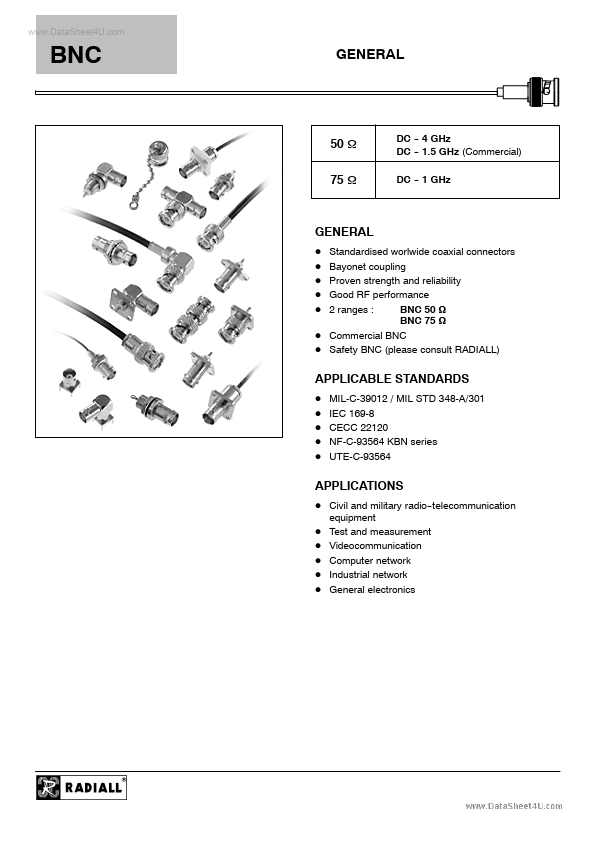
GENERAL
50 Ω 75 Ω
DC
- 4 GHz DC
- 1.5 GHz (mercial) DC
- 1 GHz
GENERAL
Standardised worlwide coaxial connectors Bayonet coupling Proven strength and reliability Good RF performance 2 ranges : BNC 50 Ω BNC 75 Ω D mercial BNC D Safety BNC (please consult RADIALL) D D D D D
APPLICABLE STANDARDS
D D D D D MIL-C-39012 / MIL STD 348-A/301 IEC 169-8 CECC 22120 NF-C-93564 KBN series UTE-C-93564
APPLICATIONS
D Civil and military radio--telemunication equipment D Test and measurement D Videomunication D puter network D Industrial network D General electronics
..
BNC 50 Ω
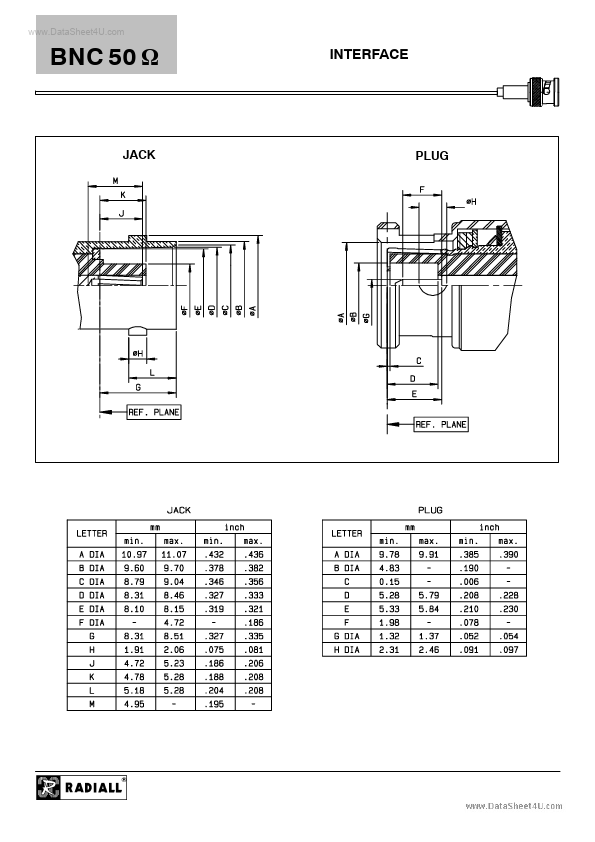
INTERFACE
JACK
PLUG
..
BNC 50 Ω
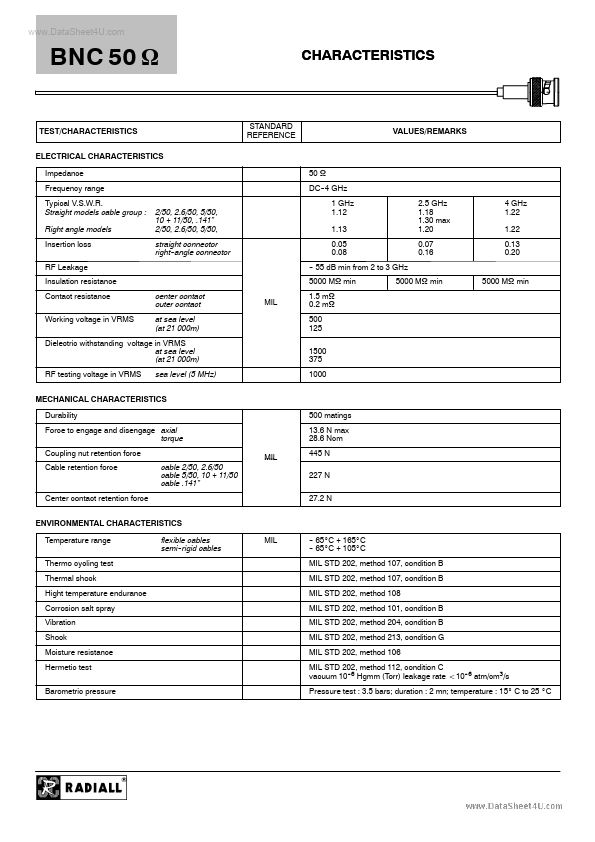
TEST/CHARACTERISTICS ELECTRICAL CHARACTERISTICS Impedance Frequency range Typical V.S.W.R. Straight models cable group : Right angle models Insertion loss RF Leakage Insulation resistance Contact resistance Working voltage in VRMS center contact outer contact at sea level (at 21 000m) MIL 2/50, 2.6/50, 5/50, 10 + 11/50, .141” 2/50, 2.6/50, 5/50, straight connector right- angle connector STANDARD REFERENCE
CHARACTERISTICS
VALUES/REMARKS
50 Ω DC-4 GHz 1 GHz 1.12 1.13 0.05 0.08
- 55 dB min from 2 to 3 GHz 5000 MΩ min 1.5 mΩ 0.2 mΩ 500 125 1500 375 1000 5000 MΩ min 5000 MΩ min 2.5 GHz 1.18 1.30 max 1.20 0.07 0.16 4 GHz 1.22 1.22 0.13 0.20
Dielectric withstanding voltage in VRMS at sea level (at 21 000m) RF testing voltage in VRMS sea level (5 MHz)
MECHANICAL CHARACTERISTICS Durability Force to engage and disengage axial torque Coupling nut retention force Cable retention force cable 2/50, 2.6/50 cable 5/50, 10 + 11/50 cable .141” MIL 500 matings 13.6 N max 28.6 Ncm 445 N 227 N 27.2 N
Center contact retention force ENVIRONMENTAL CHARACTERISTICS Temperature range Thermo cycling test Thermal...