

Datasheet4U Logo Datasheet4U.com

ACPL-054L - Digital Optocoupler

Download the ACPL-054L datasheet PDF. This datasheet also covers the ACPL-M50L variant, as both devices belong to the same digital optocoupler family and are provided as variant models within a single manufacturer datasheet.

General Description

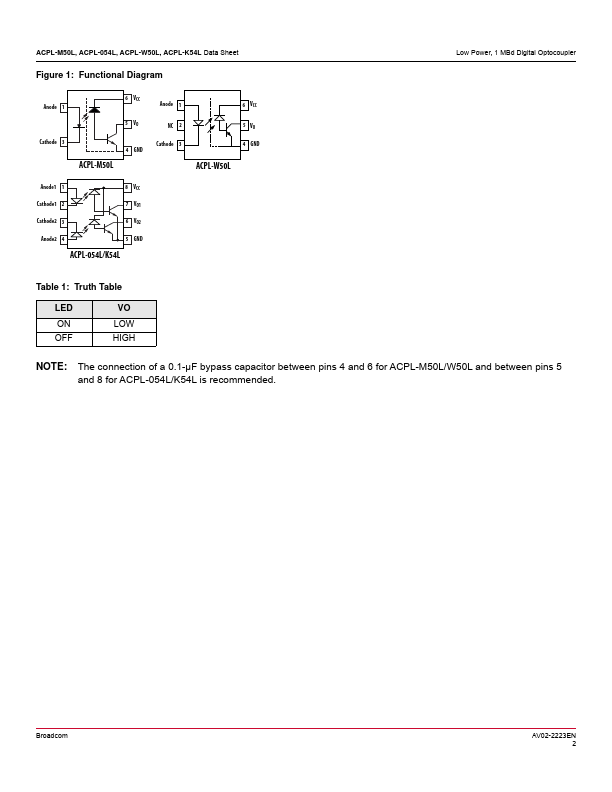
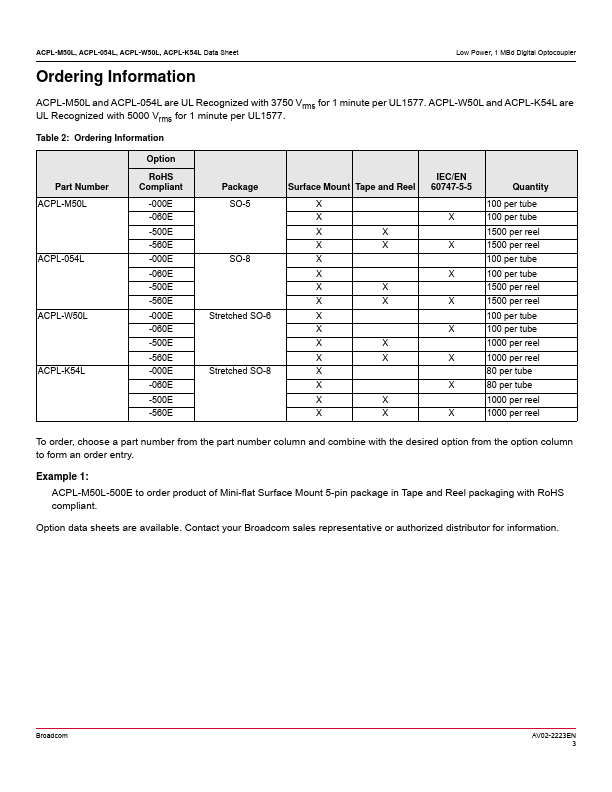
The Broadcom® ACPL-M50L (single-channel in SO-5 footprint), ACPL-054L (dual-channel in SO-8 footprint), ACPL-W50L (single-channel in stretched SO-6 footprint), and ACPL-K54L (dual-channel in stretched SO-8 footprint) are low power, low-input current, 1-MBd digital optocouplers.

Key Features

  • Wide supply voltage VCC: 2.7V to 24V.
  • Low drive current: 3 mA.
  • Open-collector output.
  • TTL compatible.
  • Compact SO-5, SO-8, stretched SO-6, and stretched SO-8 package.
  • 15 kV/µs high common-mode rejection at VCM = 1500V.
  • Guaranteed performance from temperature range:.
  • 40°C to +105°C.
  • Low propagation delay: 1 µs max at 5V.
  • Worldwide safety approval:.
  • UL1577 recognized, 3750 Vrms/1 min for ACPLM50L/054L, 5000 Vrms/1 min for ACPL-W50L/K54.

📥 Download Datasheet

Note: The manufacturer provides a single datasheet file (ACPL-M50L-Broadcom.pdf) that lists specifications for multiple related part numbers.

Full PDF Text Transcription (Reference)

The following content is an automatically extracted verbatim text from the original manufacturer datasheet and is provided for reference purposes only.

View original datasheet text
ACPL-M50L, ACPL-054L, ACPL-W50L, ACPL-K54L Low Power, 1 MBd Digital Optocoupler Data Sheet Description The Broadcom® ACPL-M50L (single-channel in SO-5 footprint), ACPL-054L (dual-channel in SO-8 footprint), ACPL-W50L (single-channel in stretched SO-6 footprint), and ACPL-K54L (dual-channel in stretched SO-8 footprint) are low power, low-input current, 1-MBd digital optocouplers. These digital optocouplers use an insulating layer between the light-emitting diode and an integrated photon detector to provide electrical insulation between input and output. Separate connections for the photodiode bias and output transistor collector increase the speed up to a hundred times over that of a conventional photo-transistor coupler by reducing the base-collector capacitance.