• Part: M-8870
  • Description: DTMF Receiver
  • Manufacturer: Clare
  • Size: 507.32 KB
Download M-8870 Datasheet PDF
Clare
M-8870
M-8870 is DTMF Receiver manufactured by Clare.
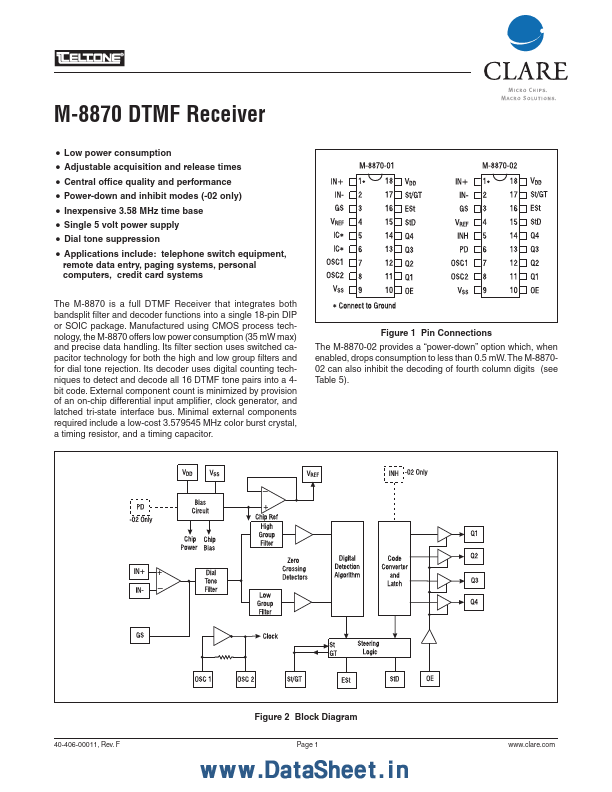
M-8870 DTMF Receiver - - - - - - - - Low power consumption Adjustable acquisition and release times Central office quality and performance Power-down and inhibit modes (-02 only) Inexpensive 3.58 MHz time base Single 5 volt power supply Dial tone suppression Applications include: telephone switch equipment, remote data entry, paging systems, personal puters, credit card systems The M-8870 is a full DTMF Receiver that integrates both bandsplit filter and decoder functions into a single 18-pin DIP or SOIC package. Manufactured using CMOS process technology, the M-8870 offers low power consumption (35 m W max) and precise data handling. Its filter section uses switched capacitor technology for both the high and low group filters and for dial tone rejection. Its decoder uses digital counting techniques to detect and decode all 16 DTMF tone pairs into a 4bit code. External ponent count is minimized by provision of an on-chip differential input amplifier, clock generator, and latched tri-state interface bus. Minimal external ponents required include a low-cost 3.579545 MHz color burst crystal, a timing resistor, and a timing capacitor. Figure 1 Pin Connections The M-8870-02 provides a “power-down” option which, when enabled, drops consumption to less than 0.5 m W. The M-887002 can also inhibit the decoding of fourth column digits (see Table 5). Figure 2 Block Diagram 40-406-00011, Rev. F Page 1 .clare. M-8870 Functional Description M-8870 operating functions (see Figure 2) include a bandsplit filter that separates the high and low tones of the received pair, and a digital decoder that verifies both the frequency and duration of the received tones before passing the resulting 4-bit code to the output bus. Filter The low and high group tones are separated by applying the dual-tone signal to the inputs of two 6th order switched capacitor bandpass filters with bandwidths that correspond to the bands enclosing the low and high group tones. The filter also...