• Part: M-991-02SM
  • Description: Call Progress Tone Generator
  • Manufacturer: Clare
  • Size: 171.03 KB
Download M-991-02SM Datasheet PDF
Clare
M-991-02SM
M-991-02SM is Call Progress Tone Generator manufactured by Clare.
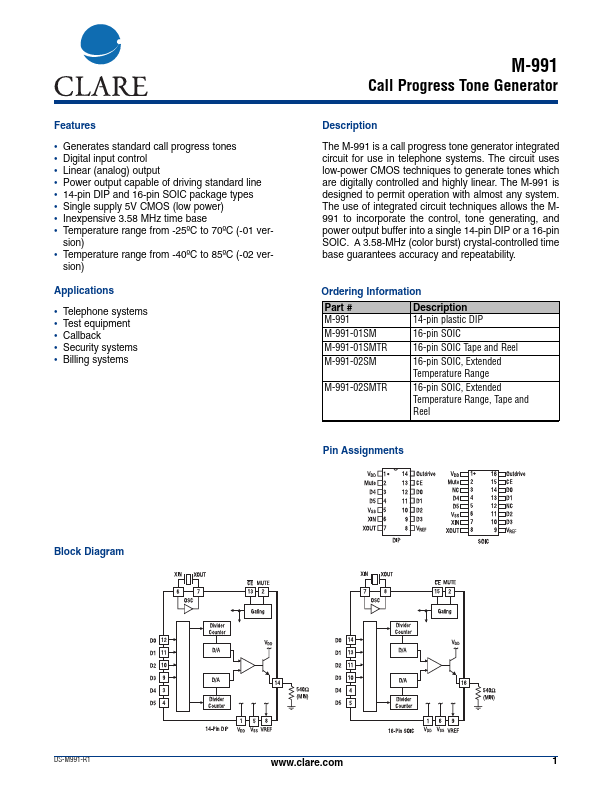
Features Generates standard call progress tones Digital input control Linear (analog) output Power output capable of driving standard line 14-pin DIP and 16-pin SOIC package types Single supply 5V CMOS (low power) Inexpensive 3.58 MHz time base Temperature range from -25ºC to 70ºC (-01 version) - Temperature range from -40ºC to 85ºC (-02 version) - - - - - - - - Applications - - - - - Telephone systems Test equipment Callback Security systems Billing systems Description The M-991 is a call progress tone generator integrated circuit for use in telephone systems. The circuit uses low-power CMOS techniques to generate tones which are digitally controlled and highly linear. The M-991 is designed to permit operation with almost any system. The use of integrated circuit techniques allows the M991 to incorporate the control, tone generating, and power output buffer into a single 14-pin DIP or a 16-pin SOIC. A 3.58-MHz (color burst) crystal-controlled time base guarantees accuracy and repeatability. Ordering Information Part # M-991 M-991-01SM M-991-01SMTR M-991-02SM M-991-02SMTR Description 14-pin plastic DIP 16-pin SOIC 16-pin SOIC Tape and Reel 16-pin SOIC, Extended Temperature Range 16-pin SOIC, Extended Temperature Range, Tape and Reel Pin Assignments Block Diagram DS-M991-R1 .clare. M-991 Absolute Maximum Ratings Storage Temperature Operating Ambient Temperature Operating Ambient Temperature for the M-991-02SM VDD Any Input Voltage -55° to 125° C -25° to 70° C -40° to 85° C 7.0V VSS -0.6 to VDD +0.6V Absolute Maximum Ratings are stress ratings. Stresses in excess of these ratings can cause permanent damage to the device. Functional operation of the device at these or any other conditions beyond those indicated in the operational sections of this data sheet is not implied. Exposure of the device to the absolute maximum ratings for an extended period may degrade the device and effect its reliability. Note: 1. Exceeding these ratings may permanently damage...