

Datasheet4U Logo Datasheet4U.com

ZXLD1370 - 60V HIGH ACCURACY BUCK/BOOST/BUCK-BOOST LED DRIVER CONTROLLER

Description

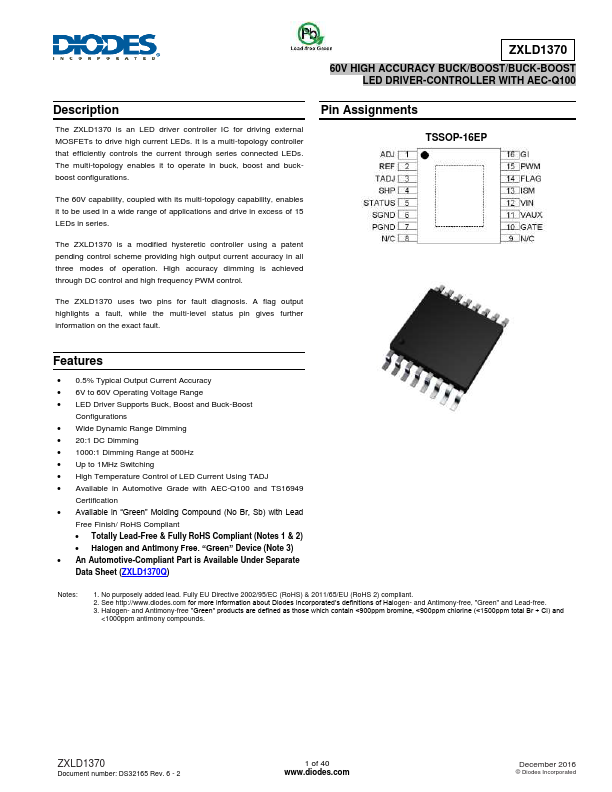
The ZXLD1370 is an LED driver controller IC for driving external MOSFETs to drive high current LEDs.

It is a multi-topology controller that efficiently controls the current through series connected LEDs.

The multi-topology enables it to operate in buck, boost and buckboost configurations.

Features

  • 0.5% Typical Output Current Accuracy.
  • 6V to 60V Operating Voltage Range.
  • LED Driver Supports Buck, Boost and Buck-Boost Configurations.
  • Wide Dynamic Range Dimming.
  • 20:1 DC Dimming.
  • 1000:1 Dimming Range at 500Hz.
  • Up to 1MHz Switching.
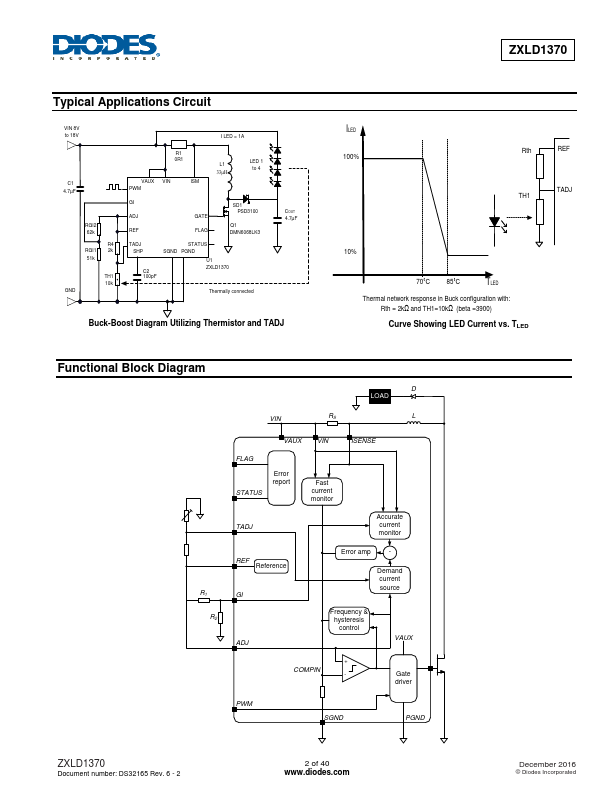
  • High Temperature Control of LED Current Using TADJ.
  • Available in Automotive Grade with AEC-Q100 and TS16949 Certification.
  • Available in “Green” Molding Compound (No Br, Sb) with Lead Free Finish/ RoHS Compliant.

📥 Download Datasheet

Datasheet preview – ZXLD1370

Datasheet Details

Part number ZXLD1370
Manufacturer Diodes Incorporated
File Size 1.31 MB
Description 60V HIGH ACCURACY BUCK/BOOST/BUCK-BOOST LED DRIVER CONTROLLER
Datasheet download datasheet ZXLD1370 Datasheet
Additional preview pages of the ZXLD1370 datasheet.
Other Datasheets by Diodes

Full PDF Text Transcription

Click to expand full text
ZXLD1370 60V HIGH ACCURACY BUCK/BOOST/BUCK-BOOST LED DRIVER-CONTROLLER WITH AEC-Q100 Description The ZXLD1370 is an LED driver controller IC for driving external MOSFETs to drive high current LEDs. It is a multi-topology controller that efficiently controls the current through series connected LEDs. The multi-topology enables it to operate in buck, boost and buckboost configurations. The 60V capability, coupled with its multi-topology capability, enables it to be used in a wide range of applications and drive in excess of 15 LEDs in series. The ZXLD1370 is a modified hysteretic controller using a patent pending control scheme providing high output current accuracy in all three modes of operation. High accuracy dimming is achieved through DC control and high frequency PWM control.
Published: |