74F169
74F169 is 4-Stage Synchronous Bidirectional Counter manufactured by Fairchild Semiconductor.
Description
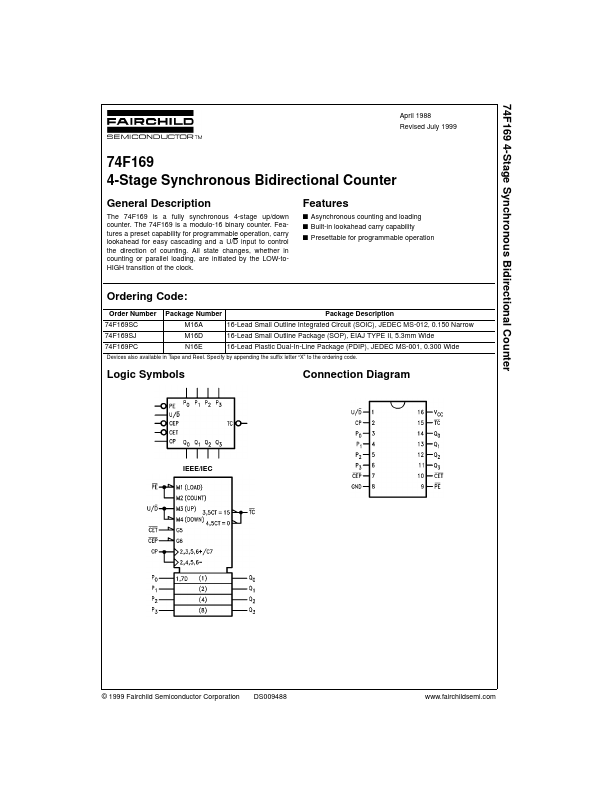
The 74F169 is a fully synchronous 4-stage up/down counter. The 74F169 is a modulo-16 binary counter. Features a preset capability for programmable operation, carry lookahead for easy cascading and a U/D input to control the direction of counting. All state changes, whether in counting or parallel loading, are initiated by the LOW-to HIGH transition of the clock.
Features s Asynchronous counting and loading s Built-in lookahead carry capability s Presettable for programmable operation
Ordering Code:
Order Number 74F169SC 74F169SJ 74F169PC Package Number M16A M16D N16E Package Description
16-Lead Small Outline Integrated Circuit (SOIC), JEDEC MS-012, 0.150 Narrow 16-Lead Small Outline Package (SOP), EIAJ TYPE II, 5.3mm Wide 16-Lead Plastic Dual-In-Line Package (PDIP), JEDEC MS-001, 0.300 Wide
Devices also available in Tape and Reel. Specify by appending the suffix letter “X” to the ordering code.
Logic Symbols
Connection Diagram
IEEE/IEC
© 1999 Fairchild Semiconductor Corporation
DS009488
.fairchildsemi.
Unit Loading/Fan Out
Pin Names CEP CET CP P0- P3 PE U/D Q0- Q3 TC Description
Count Enable Parallel Input (Active LOW) Count Enable Trickle Input (Active LOW) Clock Pulse Input (Active Rising Edge) Parallel Data Inputs Parallel Enable Input (Active LOW) Up-Down Count Control Input Flip-Flop Outputs Terminal Count Output (Active LOW) U.L. HIGH/LOW 1.0/1.0 1.0/2.0 1.0/1.0 1.0/1.0 1.0/1.0 1.0/1.0 50/33.3 50/33.3 Input IIH/IIL Output IOH/IOL 20 µA/- 0.6 m A 20 µA/- 1.2 m A 20 µA/- 0.6 m A 20 µA/- 0.6 m A 20 µA/- 0.6 m A 20 µA/- 0.6 m A
- 1 m A/20 m A
- 1 m A/20 m A
Functional Description
The 74F169 uses edge-triggered J-K type flip-flops and has no constraints on changing the control or data input signals in either state of the clock. The only requirement is that the various inputs attain the desired state at least a setup time before the rising edge of the clock and remain valid for the remended hold time thereafter. The parallel load operation takes...