Datasheet4U Logo Datasheet4U.com

G79L06 - (G79Lxx) NEGATIVE VOLTAGE REGULATOR

Download the G79L06 datasheet PDF. This datasheet also covers the G79L05 variant, as both devices belong to the same (g79lxx) negative voltage regulator family and are provided as variant models within a single manufacturer datasheet.

Description

The G79LXX series of fixed-voltage monolithic integrated circuit voltage regulators are designed for a wide range of applications.

Features

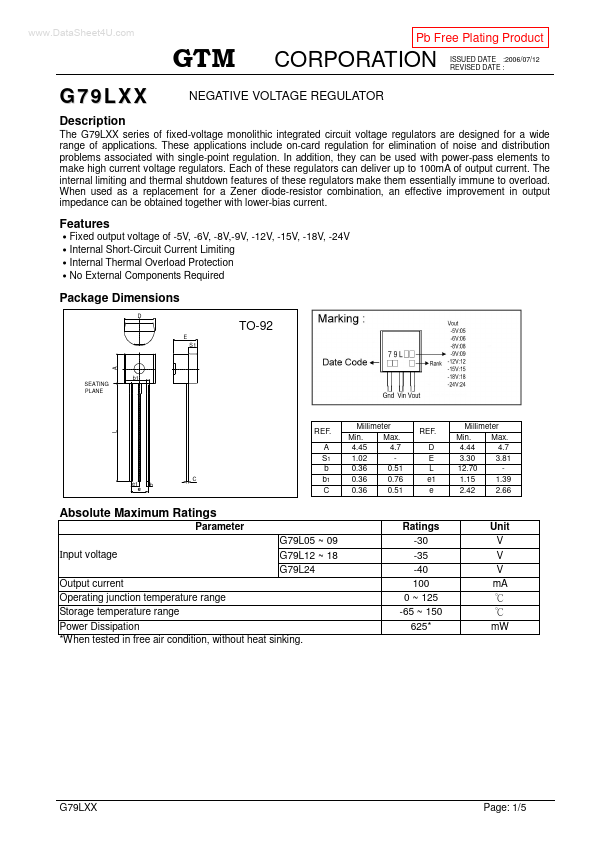
  • of these regulators make them essentially immune to overload. When used as a replacement for a Zener diode-resistor combination, an effective improvement in output impedance can be obtained together with lower-bias current. Features Fixed output voltage of -5V, -6V, -8V,-9V, -12V, -15V, -18V, -24V Internal Short-Circuit Current Limiting Internal Thermal Overload Protection No External Components Required Package Dimensions D TO-92 E S1 A b1.

📥 Download Datasheet

Note: The manufacturer provides a single datasheet file (G79L05_GTM.pdf) that lists specifications for multiple related part numbers.

Datasheet Details

Part number G79L06
Manufacturer GTM
File Size 347.35 KB
Description (G79Lxx) NEGATIVE VOLTAGE REGULATOR
Datasheet download datasheet G79L06 Datasheet

Full PDF Text Transcription (Reference)

The following content is an automatically extracted verbatim text from the original manufacturer datasheet and is provided for reference purposes only.

View original datasheet text
www.DataSheet4U.com Pb Free Plating Product CORPORATION G79LXX Description NEGATIVE VOLTAGE REGULATOR ISSUED DATE :2006/07/12 REVISED DATE : The G79LXX series of fixed-voltage monolithic integrated circuit voltage regulators are designed for a wide range of applications. These applications include on-card regulation for elimination of noise and distribution problems associated with single-point regulation. In addition, they can be used with power-pass elements to make high current voltage regulators. Each of these regulators can deliver up to 100mA of output current. The internal limiting and thermal shutdown features of these regulators make them essentially immune to overload.
Published: |