

Datasheet4U Logo Datasheet4U.com

MSA-0400 - Cascadable Silicon Bipolar MMIC Amplifier

Download the MSA-0400 datasheet PDF. This datasheet also covers the MSA-0400_Hewlett variant, as both devices belong to the same cascadable silicon bipolar mmic amplifier family and are provided as variant models within a single manufacturer datasheet.

Description

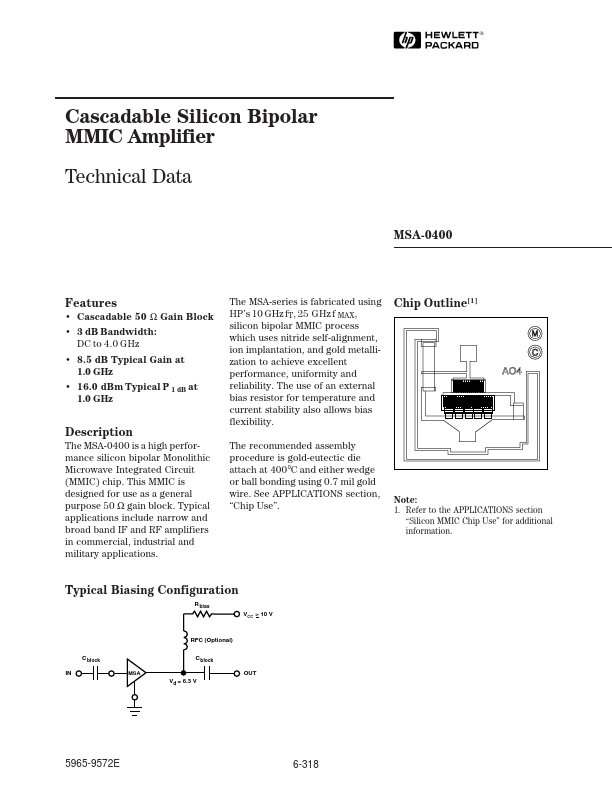
The MSA-0400 is a high performance silicon bipolar Monolithic Microwave Integrated Circuit (MMIC) chip.

This MMIC is designed for use as a general purpose 50 Ω gain block.

Typical applications include narrow and broad band IF and RF amplifiers in commercial, industrial and military applications.

Features

  • Cascadable 50 Ω Gain Block.
  • 3 dB Bandwidth: DC to 4.0 GHz.
  • 8.5 dB Typical Gain at 1.0␣ GHz.
  • 16.0␣ dBm Typical P 1 dB at 1.0␣ GHz The MSA-series is fabricated using HP’s 10 GHz fT, 25␣ GHz f MAX, silicon bipolar MMIC process which uses nitride self-alignment, ion implantation, and gold metallization to achieve excellent performance, uniformity and reliability. The use of an external bias resistor for temperature and current stability also allows bias flexibil.

📥 Download Datasheet

Note: The manufacturer provides a single datasheet file (MSA-0400_Hewlett-Packard.pdf) that lists specifications for multiple related part numbers.

Datasheet Details

Part number MSA-0400
Manufacturer Hewlett-Packard
File Size 57.42 KB
Description Cascadable Silicon Bipolar MMIC Amplifier
Datasheet download datasheet MSA-0400 Datasheet

Full PDF Text Transcription (Reference)

The following content is an automatically extracted verbatim text from the original manufacturer datasheet and is provided for reference purposes only.

View original datasheet text
Cascadable Silicon Bipolar MMIC␣ Amplifier Technical Data MSA-0400 Features • Cascadable 50 Ω Gain Block • 3 dB Bandwidth: DC to 4.0 GHz • 8.5 dB Typical Gain at 1.0␣ GHz • 16.0␣ dBm Typical P 1 dB at 1.0␣ GHz The MSA-series is fabricated using HP’s 10 GHz fT, 25␣ GHz f MAX, silicon bipolar MMIC process which uses nitride self-alignment, ion implantation, and gold metallization to achieve excellent performance, uniformity and reliability. The use of an external bias resistor for temperature and current stability also allows bias flexibility. The recommended assembly procedure is gold-eutectic die attach at 400°C and either wedge or ball bonding using 0.7 mil gold wire. See APPLICATIONS section, “Chip Use”.
Published: |