

Datasheet4U Logo Datasheet4U.com

HMC625LP5E - GaAs MMIC 5-BIT DIGITAL PHASE SHIFTER

Download the HMC625LP5E datasheet PDF. This datasheet also covers the HMC625LP5 variant, as both devices belong to the same gaas mmic 5-bit digital phase shifter family and are provided as variant models within a single manufacturer datasheet.

General Description

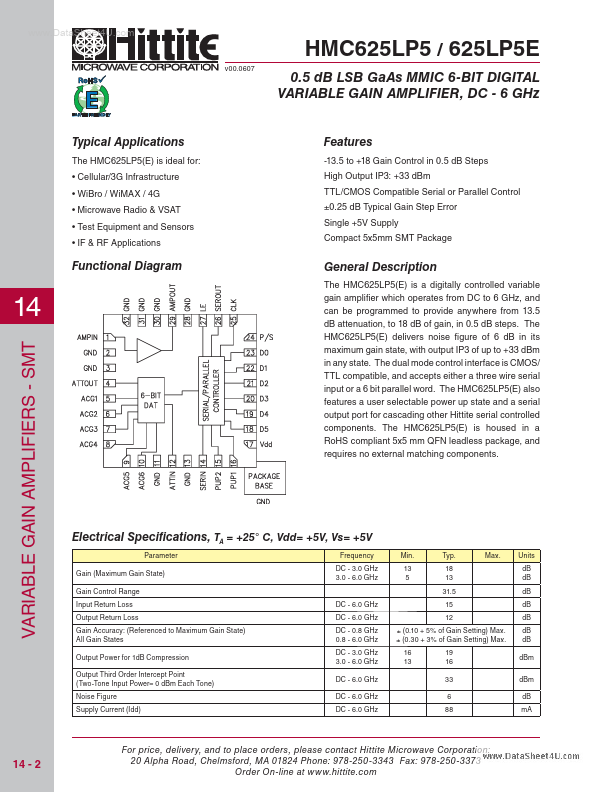
The HMC625LP5(E) is a digitally controlled variable gain amplifier which operates from DC to 6 GHz, and can be programmed to provide anywhere from 13.5 dB attenuation, to 18 dB of gain, in 0.5 dB steps.

Key Features

  • -13.5 to +18 Gain Control in 0.5 dB Steps High Output IP3: +33 dBm TTL/CMOS Compatible Serial or Parallel Control ±0.25 dB Typical Gain Step Error Single +5V Supply Compact 5x5mm SMT Package Functional Diagram General.

📥 Download Datasheet

Note: The manufacturer provides a single datasheet file (HMC625LP5_HittiteMicrowaveCorporation.pdf) that lists specifications for multiple related part numbers.

Datasheet Details

Part number HMC625LP5E
Manufacturer Hittite Microwave Corporation
File Size 547.27 KB
Description GaAs MMIC 5-BIT DIGITAL PHASE SHIFTER
Datasheet download datasheet HMC625LP5E Datasheet

Full PDF Text Transcription (Reference)

The following content is an automatically extracted verbatim text from the original manufacturer datasheet and is provided for reference purposes only.

View original datasheet text
www.DataSheet4U.com HMC625LP5 / 625LP5E v00.0607 0.5 dB LSB GaAs MMIC 6-BIT DIGITAL VARIABLE GAIN AMPLIFIER, DC - 6 GHz Typical Applications The HMC625LP5(E) is ideal for: • Cellular/3G Infrastructure • WiBro / WiMAX / 4G • Microwave Radio & VSAT • Test Equipment and Sensors • IF & RF Applications Features -13.5 to +18 Gain Control in 0.5 dB Steps High Output IP3: +33 dBm TTL/CMOS Compatible Serial or Parallel Control ±0.25 dB Typical Gain Step Error Single +5V Supply Compact 5x5mm SMT Package Functional Diagram General Description The HMC625LP5(E) is a digitally controlled variable gain amplifier which operates from DC to 6 GHz, and can be programmed to provide anywhere from 13.5 dB attenuation, to 18 dB of gain, in 0.5 dB steps.