Datasheet4U Logo Datasheet4U.com

ICS9250-12 - Frequency Generator & Integrated Buffers

General Description

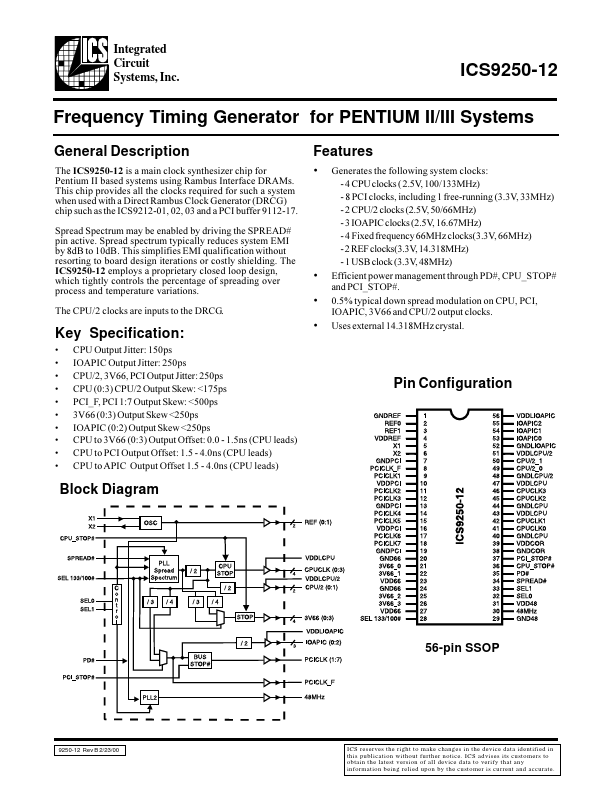
The ICS9250-12 is a main clock synthesizer chip for Pentium II based systems using Rambus Interface DRAMs.

This chip provides all the clocks required for such a system when used with a Direct Rambus Clock Generator (DRCG) chip such as the ICS9212-01, 02, 03 and a PCI buffer 9112-17.

Key Features

  • • Generates the following system clocks: - 4 CPU clocks ( 2.5V, 100/133MHz) - 8 PCI clocks, including 1 free-running (3.3V, 33MHz) - 2 CPU/2 clocks (2.5V, 50/66MHz) - 3 IOAPIC clocks (2.5V, 16.67MHz) - 4 Fixed frequency 66MHz clocks(3.3V, 66MHz) - 2 REF clocks(3.3V, 14.318MHz) - 1 USB clock (3.3V, 48MHz) Efficient power management through PD#, CPU_STOP# and PCI_STOP#. 0.5% typical down spread modulation on CPU, PCI, IOAPIC, 3V66 and CPU/2 output clocks. Uses external 14.318MHz crystal. • • • K.

📥 Download Datasheet

Datasheet Details

Part number ICS9250-12
Manufacturer Integrated Circuit Systems
File Size 395.23 KB
Description Frequency Generator & Integrated Buffers
Datasheet download datasheet ICS9250-12 Datasheet

Full PDF Text Transcription (Reference)

The following content is an automatically extracted verbatim text from the original manufacturer datasheet and is provided for reference purposes only.

View original datasheet text
Integrated Circuit Systems, Inc. ICS9250-12 Frequency Timing Generator for PENTIUM II/III Systems General Description The ICS9250-12 is a main clock synthesizer chip for Pentium II based systems using Rambus Interface DRAMs. This chip provides all the clocks required for such a system when used with a Direct Rambus Clock Generator (DRCG) chip such as the ICS9212-01, 02, 03 and a PCI buffer 9112-17. Spread Spectrum may be enabled by driving the SPREAD# pin active. Spread spectrum typically reduces system EMI by 8dB to 10dB. This simplifies EMI qualification without resorting to board design iterations or costly shielding. The ICS9250-12 employs a proprietary closed loop design, which tightly controls the percentage of spreading over process and temperature variations.