Datasheet4U Logo Datasheet4U.com

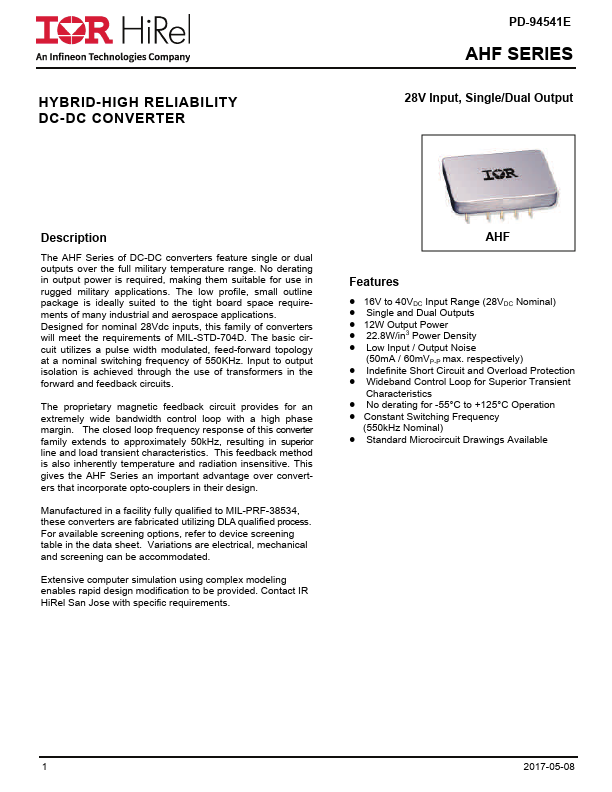
AHF2815D - HYBRID-HIGH RELIABILITY DC-DC CONVERTER

Download the AHF2815D datasheet PDF. This datasheet also covers the AHF28xx variant, as both devices belong to the same hybrid-high reliability dc-dc converter family and are provided as variant models within a single manufacturer datasheet.

Description

The AHF Series of DC-DC converters feature single or dual outputs over the full military temperature range.

No derating in output power is required, making them suitable for use in rugged military applications.

Features

  •  16V to 40VDC Input Range (28VDC Nominal).
  •  Single and Dual Outputs.
  •  12W Output Power.
  •  22.8W/in3 Power Density.
  •  Low Input / Output Noise (50mA / 60mVP-P max. respectively).
  •  Indefinite Short Circuit and Overload Protection.
  •  Wideband Control Loop for Superior Transient Characteristics.
  •  No derating for -55°C to +125°C Operation.
  •  Constant Switching Frequency (550kHz Nominal).
  •  Standard Microcircuit Drawings Available 1 2017-05-08 AHF.

📥 Download Datasheet

Note: The manufacturer provides a single datasheet file (AHF28xx_InternationalRectifier.pdf) that lists specifications for multiple related part numbers.

Full PDF Text Transcription

Click to expand full text
HYBRID-HIGH RELIABILITY DC-DC CONVERTER PD-94541E AHF SERIES 28V Input, Single/Dual Output   Description The AHF Series of DC-DC converters feature single or dual outputs over the full military temperature range. No derating in output power is required, making them suitable for use in rugged military applications. The low profile, small outline package is ideally suited to the tight board space requirements of many industrial and aerospace applications. Designed for nominal 28Vdc inputs, this family of converters will meet the requirements of MIL-STD-704D. The basic circuit utilizes a pulse width modulated, feed-forward topology at a nominal switching frequency of 550KHz. Input to output isolation is achieved through the use of transformers in the forward and feedback circuits.
Published: |