
Datasheet4U Logo Datasheet4U.com

EL2141 - 150MHz Differential Twisted Pair Driver

Download the EL2141 datasheet PDF. This datasheet also covers the EL2140 variant, as both devices belong to the same 150mhz differential twisted pair driver family and are provided as variant models within a single manufacturer datasheet.

General Description

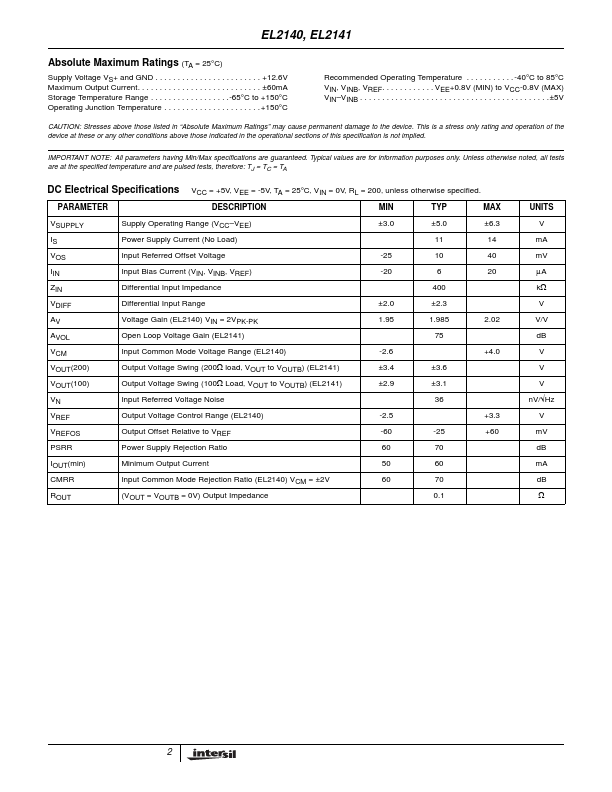
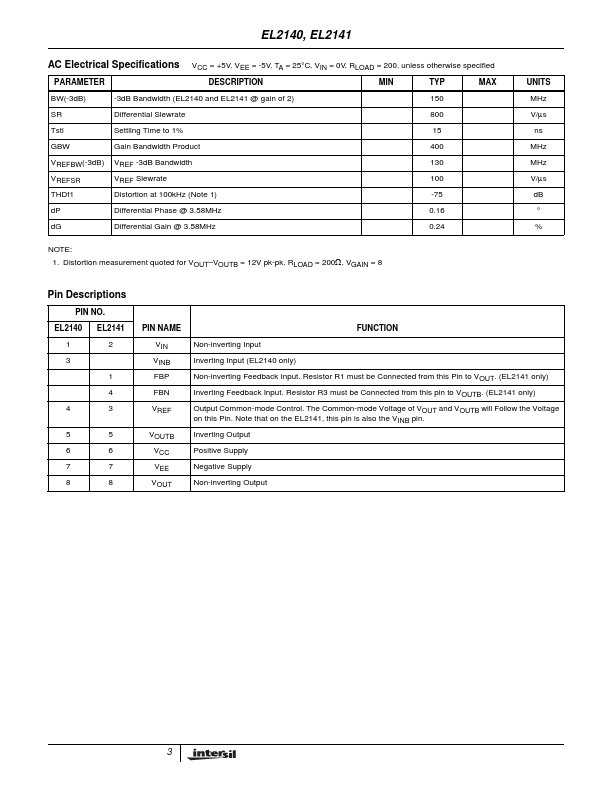
MIN TYP MAX VSUPPLY IS VOS IIN ZIN VDIFF AV AVOL VCM VOUT(200) VOUT(100) VN VREF VREFOS PSRR Supply Operating Range (VCC VEE) Power Supply Current (No Load) Input Referred Offset Voltage Input Bias Current (VIN, VINB, VREF) Differential Input Impedance Differential Input Range Voltage Gai

Key Features

  • Fully differential inputs, outputs, and feedback.
  • Differential input range ±2.3V.
  • 150MHz 3dB bandwidth.
  • 800V/µs slew rate.
  • -55dB distortion at 3MHz.
  • -75dB distortion at 100kHz.
  • ±5V supplies or +6V single supply.
  • 50mA minimum output current.
  • Output swing (200Ω load) to within 1.5V of supplies (14VPKPK differential).
  • Low power-11mA typical supply current.

📥 Download Datasheet

Note: The manufacturer provides a single datasheet file (EL2140-Intersil.pdf) that lists specifications for multiple related part numbers.

Full PDF Text Transcription (Reference)

The following content is an automatically extracted verbatim text from the original manufacturer datasheet and is provided for reference purposes only.

View original datasheet text
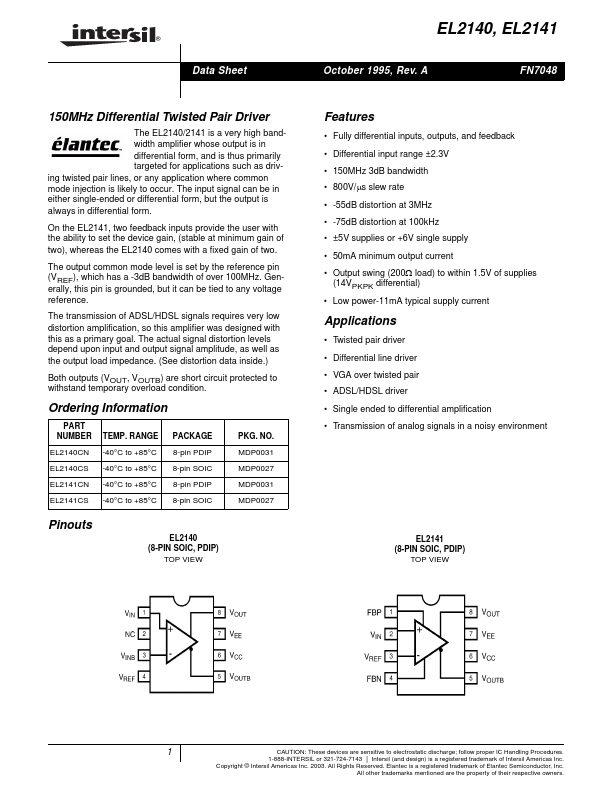
® Data Sheet EL2140, EL2141 October 1995, Rev. A FN7048 150MHz Differential Twisted Pair Driver The EL2140/2141 is a very high bandwidth amplifier whose output is in differential form, and is thus primarily targeted for applications such as driving twisted pair lines, or any application where common mode injection is likely to occur. The input signal can be in either single-ended or differential form, but the output is always in differential form. On the EL2141, two feedback inputs provide the user with the ability to set the device gain, (stable at minimum gain of two), whereas the EL2140 comes with a fixed gain of two. The output common mode level is set by the reference pin (VREF), which has a -3dB bandwidth of over 100MHz.