

Datasheet4U Logo Datasheet4U.com

HS-26CLV31EH - Radiation Hardened 3.3V Quad Differential Line Drivers

Download the HS-26CLV31EH datasheet PDF. This datasheet also covers the HS-26CLV31RH variant, as both devices belong to the same radiation hardened 3.3v quad differential line drivers family and are provided as variant models within a single manufacturer datasheet.

General Description

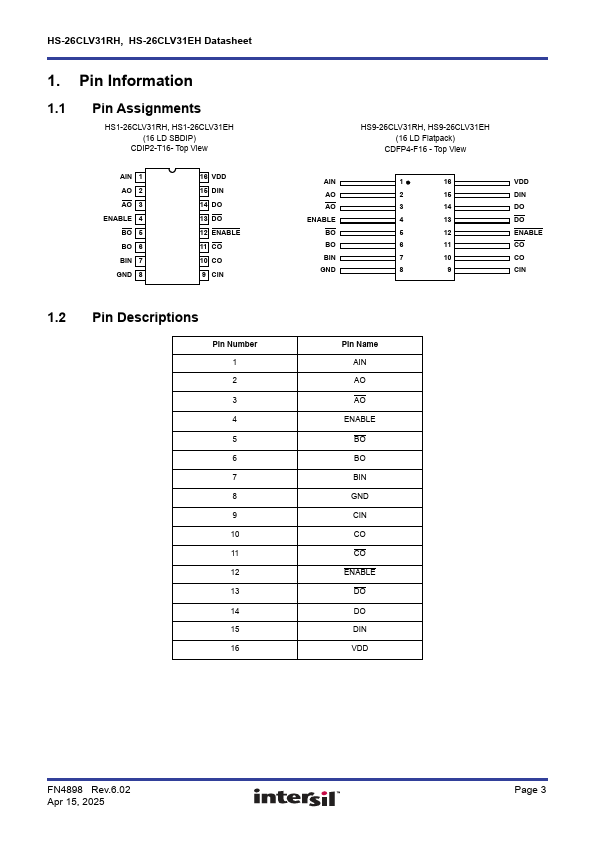
The HS-26CLV31RH, HS-26CLV31EH are radiation hardened 3.3V quad differential line drivers designed for digital data transmission over balanced lines, in low voltage RS-422 protocol applications.

Key Features

  • Electrically screened to SMD #5962-96663.
  • QML qualified per MIL-PRF-38535 requirements.
  • 1.2 micron radiation hardened CMOS.
  • Extremely low stand-by current: 100µA (maximum).
  • Operating supply range: 3.0V to 3.6V.
  • CMOS level inputs: VIH>(0.7) (VDD); VIL< (0.3) (VDD).
  • Differential outputs: VOH > 1.8V; VOL < 0.5V.
  • High impedance outputs when disabled or powered down (VDD = 0V).
  • Low output impedance: 10Ω or less.
  • Radiation acceptance testing - HS-26C3.

📥 Download Datasheet

Note: The manufacturer provides a single datasheet file (HS-26CLV31RH-Intersil.pdf) that lists specifications for multiple related part numbers.

Full PDF Text Transcription for HS-26CLV31EH (Reference)

Note: Below is a high-fidelity text extraction (approx. 800 characters) for HS-26CLV31EH. For precise diagrams, and layout, please refer to the original PDF.

HS-26CLV31RH, HS-26CLV31EH Radiation Hardened 3.3V Quad Differential Line Drivers Datasheet Description The HS-26CLV31RH, HS-26CLV31EH are radiation hardened 3.3V quad di...

View more extracted text
ion The HS-26CLV31RH, HS-26CLV31EH are radiation hardened 3.3V quad differential line drivers designed for digital data transmission over balanced lines, in low voltage RS-422 protocol applications. CMOS processing assures low power consumption, high speed, and reliable operation in the most severe radiation environments. The HS-26CLV31RH and HS-26CLV31EH accept CMOS level inputs and converts them to differential outputs. Enable pins allow several devices to be connected to the same data source and addressed independently.