
Datasheet4U Logo Datasheet4U.com

ML620Q151A - 16-bit micro controller

General Description

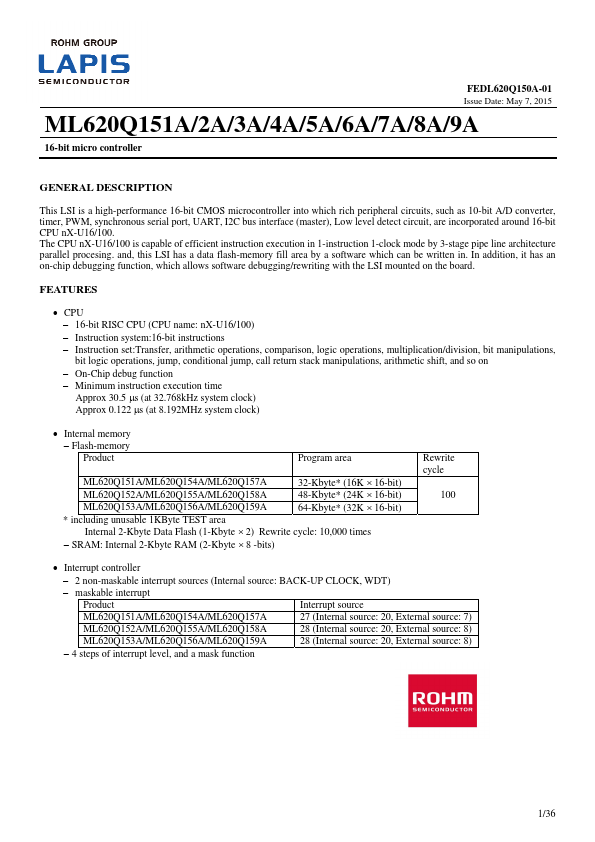
This LSI is a high-performance 16-bit CMOS microcontroller into which rich peripheral circuits, such as 10-bit A/D converter, timer, PWM, synchronous serial port, UART, I2C bus interface (master), Low level detect circuit, are incorporated around 16-bit CPU nX-U16/100.

Key Features

  • CPU.
  • 16-bit RISC CPU (CPU name: nX-U16/100).
  • Instruction system:16-bit instructions.
  • Instruction set:Transfer, arithmetic operations, comparison, logic operations, multiplication/division, bit manipulations, bit logic operations, jump, conditional jump, call return stack manipulations, arithmetic shift, and so on.
  • On-Chip debug function.
  • Minimum instruction execution time Approx 30.5 µs (at 32.768kHz system clock) Approx 0.122 µs (at 8.192M.

📥 Download Datasheet

Datasheet Details

Part number ML620Q151A
Manufacturer LAPIS Semiconductor
File Size 744.71 KB
Description 16-bit micro controller
Datasheet download datasheet ML620Q151A Datasheet

Full PDF Text Transcription for ML620Q151A (Reference)

Note: Below is a high-fidelity text extraction (approx. 800 characters) for ML620Q151A. For precise diagrams, tables, and layout, please refer to the original PDF.

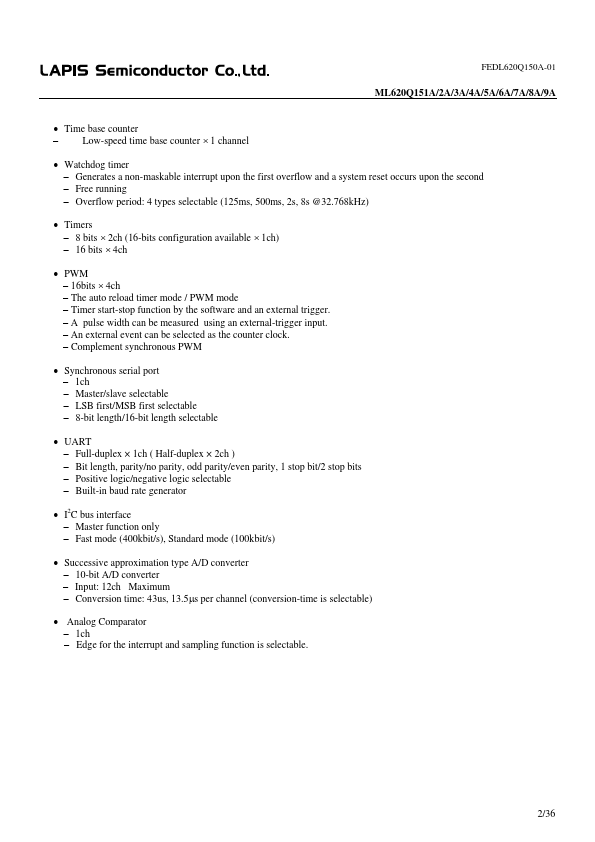
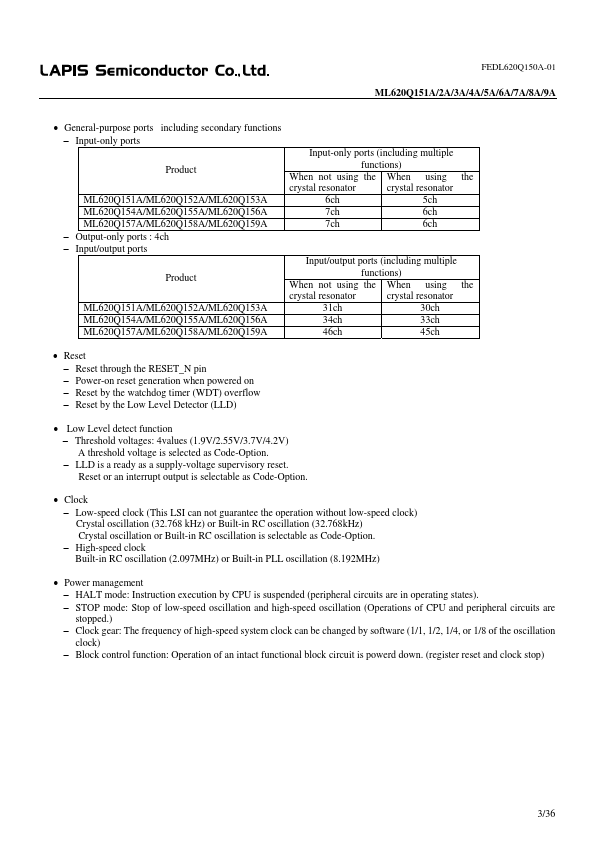
FEDL620Q150A-01 Issue Date: May 7, 2015 ML620Q151A/2A/3A/4A/5A/6A/7A/8A/9A 16-bit micro controller GENERAL DESCRIPTION This LSI is a high-performance 16-bit CMOS microcon...

View more extracted text
ENERAL DESCRIPTION This LSI is a high-performance 16-bit CMOS microcontroller into which rich peripheral circuits, such as 10-bit A/D converter, timer, PWM, synchronous serial port, UART, I2C bus interface (master), Low level detect circuit, are incorporated around 16-bit CPU nX-U16/100. The CPU nX-U16/100 is capable of efficient instruction execution in 1-instruction 1-clock mode by 3-stage pipe line architecture parallel procesing. and, this LSI has a data flash-memory fill area by a software which can be written in. In addition, it has an on-chip debugging function, which allows software debugging/rewriting with the LSI