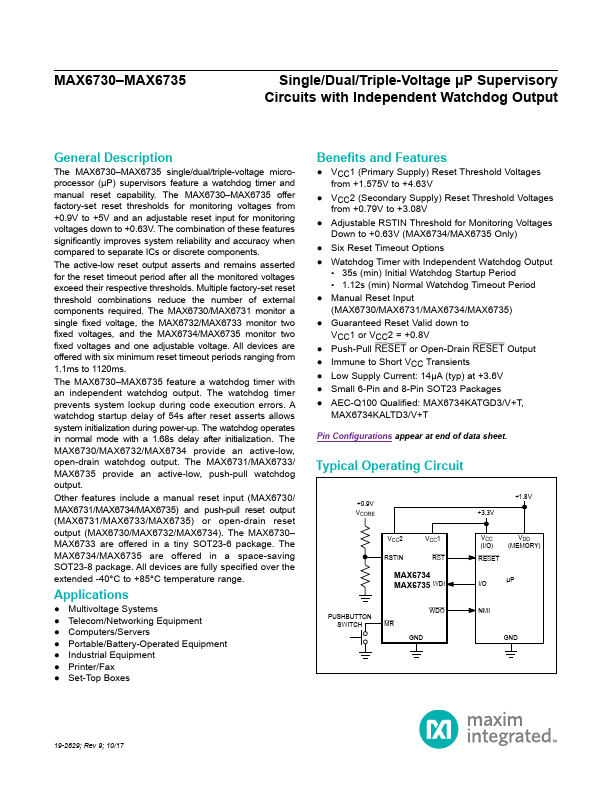
MAX6731 Overview
Key Specifications
Package: SOT-23-6
Mount Type: Surface Mount
Pins: 6
Max Voltage (typical range): 5.5 V
Description
The MAX6730–MAX6735 single-/dual-/triple-voltage microprocessor (µP) supervisors feature a watchdog timer and manual reset capability. The MAX6730– MAX6735 offer factory-set reset thresholds for monitoring voltages from +0.9V to +5V and an adjustable reset input for monitoring voltages down to +0.63V.
Key Features
- a watchdog timer and manual reset capability
- Multiple factoryset reset threshold combinations reduce the number of external components required
- All devices are offered with six minimum reset timeout periods ranging from 1.1ms to 1120ms
- The MAX6730–MAX6735 feature a watchdog timer with an independent watchdog output
- The watchdog timer prevents system lockup during code execution errors
- A watchdog startup delay of 54s after reset asserts allows system initialization during power-up
- The watchdog operates in normal mode with a 1.68s delay after initialization
- The MAX6730/MAX6732/MAX6734 provide an active-low, open-drain watchdog output
- The MAX6731/MAX6733/MAX6735 provide an active-low, push-pull watchdog output
- The MAX6730– MAX6733 are offered in a tiny SOT23-6 package