Datasheet4U Logo Datasheet4U.com

MAX17223 - nanoPower Synchronous Boost Converter

This page provides the datasheet information for the MAX17223, a member of the MAX17220 nanoPower Synchronous Boost Converter family.

Datasheet Summary

Description

The MAX17220

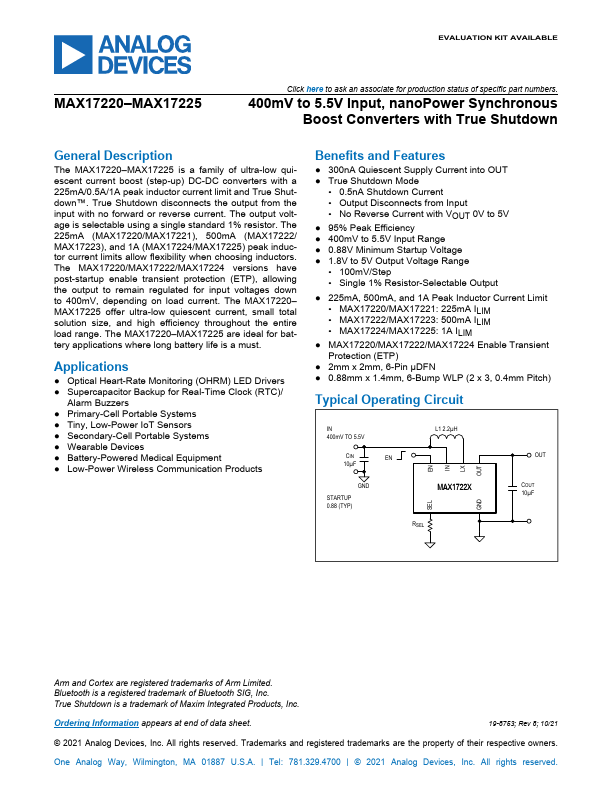
MAX17225 is a family of ultra-low quiescent current boost (step-up) DC-DC converters with a 225mA/0.5A/1A peak inductor current limit and True Shutdown™.

True Shutdown disconnects the output from the input with no forward or reverse current.

Features

  • 300nA Quiescent Supply Current into OUT.
  • True Shutdown Mode.
  • 0.5nA Shutdown Current.
  • Output Disconnects from Input.
  • No Reverse Current with VOUT 0V to 5V.
  • 95% Peak Efficiency.
  • 400mV to 5.5V Input Range.
  • 0.88V Minimum Startup Voltage.
  • 1.8V to 5V Output Voltage Range.
  • 100mV/Step.
  • Single 1% Resistor-Selectable Output.
  • 225mA, 500mA, and 1A Peak Inductor Current Limit.
  • MAX17220/MAX17221: 225mA ILIM.
  • MAX.

📥 Download Datasheet

Datasheet preview – MAX17223

Datasheet Details

Part number MAX17223
Manufacturer Maxim Integrated
File Size 1.00 MB
Description nanoPower Synchronous Boost Converter
Datasheet download datasheet MAX17223 Datasheet
Additional preview pages of the MAX17223 datasheet.
Other Datasheets by Maxim Integrated

Full PDF Text Transcription

Click to expand full text
EVALUATION KIT AVAILABLE MAX17220–MAX17225 Click here to ask an associate for production status of specific part numbers. 400mV to 5.5V Input, nanoPower Synchronous Boost Converters with True Shutdown General Description The MAX17220–MAX17225 is a family of ultra-low quiescent current boost (step-up) DC-DC converters with a 225mA/0.5A/1A peak inductor current limit and True Shutdown™. True Shutdown disconnects the output from the input with no forward or reverse current. The output voltage is selectable using a single standard 1% resistor. The 225mA (MAX17220/MAX17221), 500mA (MAX17222/ MAX17223), and 1A (MAX17224/MAX17225) peak inductor current limits allow flexibility when choosing inductors.
Published: |