



Datasheet4U Logo Datasheet4U.com

MAX1760H - Step-Up DC-DC Converter

Download the MAX1760H datasheet PDF. This datasheet also covers the MAX1760 variant, as both devices belong to the same step-up dc-dc converter family and are provided as variant models within a single manufacturer datasheet.

General Description

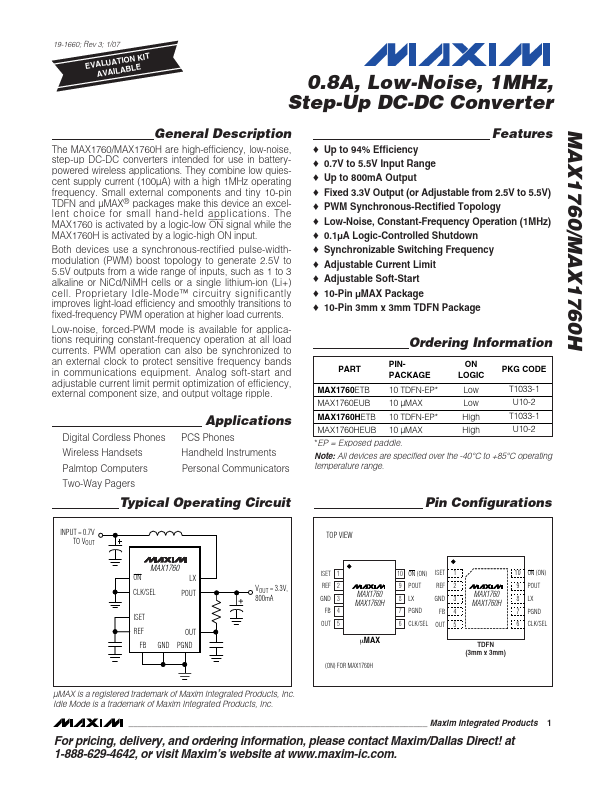
The MAX1760/MAX1760H are high-efficiency, low-noise, step-up DC-DC converters intended for use in batterypowered wireless applications.

They combine low quiescent supply current (100µA) with a high 1MHz operating frequency.

Key Features

  • Up to 94% Efficiency.
  • 0.7V to 5.5V Input Range.
  • Up to 800mA Output.
  • Fixed 3.3V Output (or Adjustable from 2.5V to 5.5V).
  • PWM Synchronous-Rectified Topology.
  • Low-Noise, Constant-Frequency Operation (1MHz).
  • 0.1µA Logic-Controlled Shutdown.
  • Synchronizable Switching Frequency.
  • Adjustable Current Limit.
  • Adjustable Soft-Start.
  • 10-Pin µMAX Package.
  • 10-Pin 3mm x 3mm TDFN Package Ordering Informa.

📥 Download Datasheet

Note: The manufacturer provides a single datasheet file (MAX1760_MaximIntegratedProducts.pdf) that lists specifications for multiple related part numbers.

Full PDF Text Transcription for MAX1760H (Reference)

Note: Below is a high-fidelity text extraction (approx. 800 characters) for MAX1760H. For precise diagrams, and layout, please refer to the original PDF.

19-1660; Rev 3; 1/07 EVAALVUAAILTAIOBNLEKIT 0.8A, Low-Noise, 1MHz, Step-Up DC-DC Converter MAX1760/MAX1760H General Description The MAX1760/MAX1760H are high-efficiency, ...

View more extracted text
AX1760H General Description The MAX1760/MAX1760H are high-efficiency, low-noise, step-up DC-DC converters intended for use in batterypowered wireless applications. They combine low quiescent supply current (100µA) with a high 1MHz operating frequency. Small external components and tiny 10-pin TDFN and µMAX® packages make this device an excellent choice for small hand-held applications. The MAX1760 is activated by a logic-low ON signal while the MAX1760H is activated by a logic-high ON input. Both devices use a synchronous-rectified pulse-widthmodulation (PWM) boost topology to generate 2.5V to 5.