

Datasheet4U Logo Datasheet4U.com

MAX16049 - (MAX16047 / MAX16049) 12-Channel/8-Channel EEPROM-Programmable System Managers

Download the MAX16049 datasheet PDF. This datasheet also covers the MAX16047 variant, as both devices belong to the same (max16047 / max16049) 12-channel/8-channel eeprom-programmable system managers family and are provided as variant models within a single manufacturer datasheet.

Description

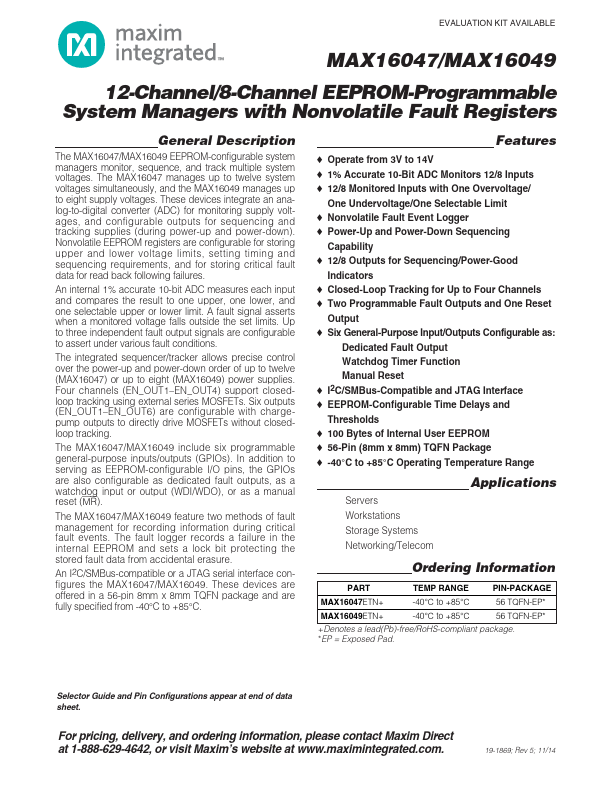
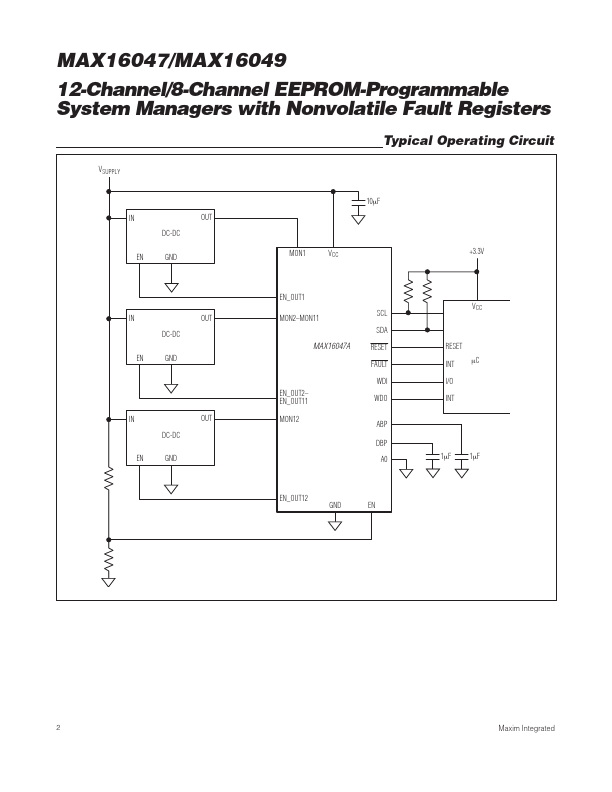
The MAX16047/MAX16049 EEPROM-configurable system managers monitor, sequence, and track multiple system voltages.

The MAX16047 manages up to twelve system voltages simultaneously, and the MAX16049 manages up to eight supply voltages.

Features

  • o Operates from 3V to 14V o 1% Accurate 10-Bit ADC Monitors 12/8 Inputs o 12/8 Monitored Inputs with One Overvoltage/ One Undervoltage/One Selectable Limit o Nonvolatile Fault Event Logger o Power-Up and Power-Down Sequencing Capability o 12/8 Outputs for Sequencing/Power-Good Indicators o Closed-Loop Tracking for Up to Four Channels o Two Programmable Fault Outputs and One Reset Output o Six General-Purpose Input/Outputs Configurable as: Dedicated Fault Output Watchdog Timer Function Manual Res.

📥 Download Datasheet

Note: The manufacturer provides a single datasheet file (MAX16047_MaximIntegratedProducts.pdf) that lists specifications for multiple related part numbers.

Full PDF Text Transcription

Click to expand full text
19-1869; Rev 0; 11/07 12-Channel/8-Channel EEPROM-Programmable System Managers with Nonvolatile Fault Registers General Description The MAX16047/MAX16049 EEPROM-configurable system managers monitor, sequence, and track multiple system voltages. The MAX16047 manages up to twelve system voltages simultaneously, and the MAX16049 manages up to eight supply voltages. These devices integrate an analog-to-digital converter (ADC) for monitoring supply voltages, and configurable outputs for sequencing and www.DataSheet4U.com tracking supplies (during power-up and power-down). Nonvolatile EEPROM registers are configurable for storing upper and lower voltage limits, setting timing and sequencing requirements, and for storing critical fault data for read back following failures.
Published: |