MAX16823
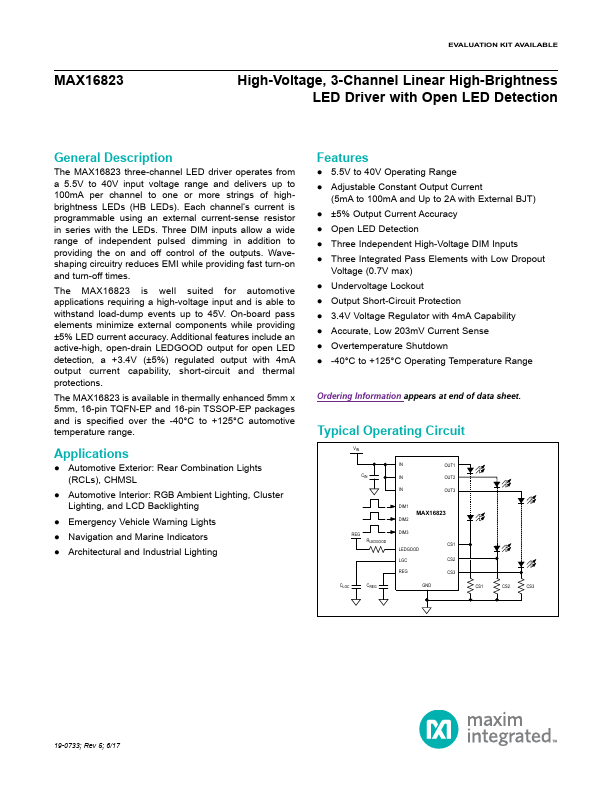
MAX16823 is 3-Channel Linear High-Brightness LED Driver manufactured by Maxim Integrated.
Description
The MAX16823 three-channel LED driver operates from a 5.5V to 40V input voltage range and delivers up to 100m A per channel to one or more strings of highbrightness LEDs (HB LEDs). Each channel’s current is programmable using an external current-sense resistor in series with the LEDs. Three DIM inputs allow a wide range of independent pulsed dimming in addition to providing the on and off control of the outputs. Waveshaping circuitry reduces EMI while providing fast turn-on and turn-off times.
The MAX16823 is well suited for automotive applications requiring a high-voltage input and is able to withstand load-dump events up to 45V. On-board pass elements minimize external ponents while providing ±5% LED current accuracy. Additional features include an active-high, open-drain LEDGOOD output for open LED detection, a +3.4V (±5%) regulated output with 4m A output current capability, short-circuit and thermal protections.
The MAX16823 is available in thermally enhanced 5mm x 5mm, 16-pin TQFN-EP and 16- pin TSSOP-EP packages and is specified over the -40°C to +125°C automotive temperature range.
Applications
- - Automotive Exterior: Rear bination Lights (RCLs), CHMSL
- - Automotive Interior: RGB Ambient Lighting, Cluster Lighting, and LCD Backlighting
- - Emergency Vehicle Warning Lights
- - Navigation and Marine Indicators
- - Architectural and Industrial Lighting
Features
- - 5.5V to 40V Operating Range
- - Adjustable Constant Output Current
(5m A to 100m A and Up to 2A with External BJT)
- - ±5% Output Current Accuracy
- - Open LED Detection
- - Three Independent High-Voltage DIM Inputs
- - Three Integrated Pass Elements with Low Dropout
Voltage (0.7V max)
- - Undervoltage Lockout
- - Output Short-Circuit Protection
- - 3.4V Voltage Regulator with 4m A Capability
- - Accurate, Low 203m V Current Sense
- - Overtemperature Shutdown
- - -40°C to +125°C Operating Temperature Range
Ordering Information appears at end of data sheet.
Typical Operating Circuit
IN CIN IN
OUT1...