• Part: TH72036
  • Description: FSK/ASK Transmitter
  • Manufacturer: Melexis
  • Size: 323.53 KB
Download TH72036 Datasheet PDF
Melexis
TH72036
TH72036 is FSK/ASK Transmitter manufactured by Melexis.
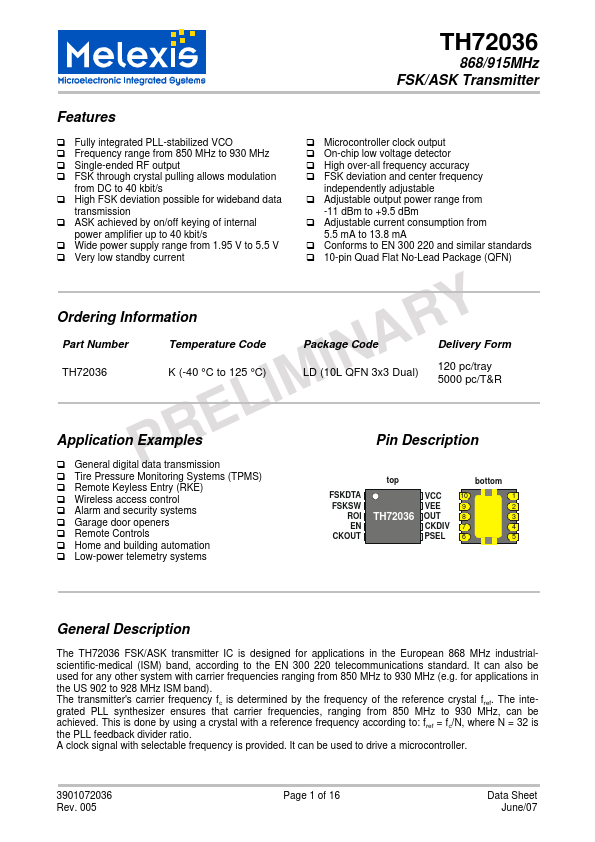
868/915MHz FSK/ASK Transmitter Features ! Fully integrated PLL-stabilized VCO ! Frequency range from 850 MHz to 930 MHz ! Single-ended RF output ! FSK through crystal pulling allows modulation from DC to 40 kbit/s ! High FSK deviation possible for wideband data transmission ! ASK achieved by on/off keying of internal power amplifier up to 40 kbit/s ! Wide power supply range from 1.95 V to 5.5 V ! Very low standby current ! Microcontroller clock output ! On-chip low voltage detector ! High over-all frequency accuracy ! FSK deviation and center frequency independently adjustable ! Adjustable output power range from -11 d Bm to +9.5 d Bm ! Adjustable current consumption from 5.5 m A to 13.8 m A ! Conforms to EN 300 220 and similar standards ! 10-pin Quad Flat No-Lead Package (QFN) YOrdering Information RPart Number Temperature Code INATH72036 K (-40 °C to 125 °C) Package Code LD (10L QFN 3x3 Dual) Delivery Form 120 pc/tray 5000 pc/T&R ELIMApplication Examples PR! General digital data transmission Pin Description ! Tire Pressure Monitoring Systems (TPMS) ! Remote Keyless Entry (RKE) top bottom ! Wireless access control ! Alarm and security systems ! Garage door openers ! Remote Controls ! Home and building automation FSKDTA FSKSW ROI EN CKOUT VCC VEE OUT CKDIV PSEL 10 9 8 7 6 1 2 3 4 5 ! Low-power telemetry systems General Description The TH72036 FSK/ASK transmitter IC is designed for applications in the European 868 MHz industrialscientific-medical (ISM) band, according to the EN 300 220 telemunications standard. It can also be used for any other system with carrier frequencies ranging from 850 MHz to 930 MHz (e.g. for applications in the US 902 to 928 MHz ISM band). The transmitter's carrier frequency fc is determined by the frequency of the reference crystal fref. The integrated PLL synthesizer ensures that carrier frequencies, ranging from 850 MHz to 930 MHz, can be achieved. This is done by using a crystal with a reference...