Datasheet4U Logo Datasheet4U.com

1N6167AUS - Voidless Hermetically Sealed Surface Mount Bidirectional Transient Voltage Suppressors

Download the 1N6167AUS datasheet PDF (1N6138AUS included). The manufacturer datasheet provides complete specifications, pinout details, electrical characteristics, and typical applications for voidless hermetically sealed surface mount bidirectional transient voltage suppressors.

Description

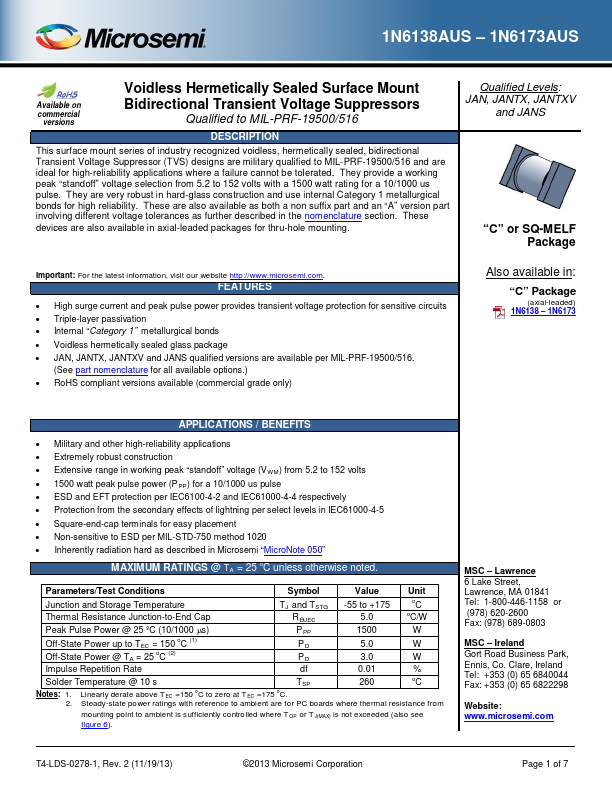
This surface mount series of industry recognized voidless, hermetically sealed, bidirectional Transient Voltage Suppressor (TVS) designs are military qualified to MIL-PRF-19500/516 and are ideal for high-reliability applications where a failure cannot be tolerated.

Features

  • High surge current and peak pulse power provides transient voltage protection for sensitive circuits.
  • Triple-layer passivation.
  • Internal “Category 1” metallurgical bonds.
  • Voidless hermetically sealed glass package.
  • JAN, JANTX, JANTXV and JANS qualified versions are available per MIL-PRF-19500/516. (See part nomenclature for all available options. ).
  • RoHS compliant versions available (commercial grade only) Also available in: “C” Package (axi.

📥 Download Datasheet

Note: The manufacturer provides a single datasheet file (1N6138AUS-Microsemi.pdf) that lists specifications for multiple related part numbers.
Other Datasheets by Microsemi

Full PDF Text Transcription

Click to expand full text
1N6138AUS – 1N6173AUS Voidless Hermetically Sealed Surface Mount Available on commercial versions Bidirectional Transient Voltage Suppressors Qualified to MIL-PRF-19500/516 DESCRIPTION This surface mount series of industry recognized voidless, hermetically sealed, bidirectional Transient Voltage Suppressor (TVS) designs are military qualified to MIL-PRF-19500/516 and are ideal for high-reliability applications where a failure cannot be tolerated. They provide a working peak “standoff” voltage selection from 5.2 to 152 volts with a 1500 watt rating for a 10/1000 us pulse. They are very robust in hard-glass construction and use internal Category 1 metallurgical bonds for high reliability.
Published: |