Datasheet4U Logo Datasheet4U.com

UM9415 - ANTENNA SWITCH DIODES

Download the UM9415 datasheet PDF. This datasheet also covers the UM9401 variant, as both devices belong to the same antenna switch diodes family and are provided as variant models within a single manufacturer datasheet.

Description

Microsemi offers a series of PIN diodes specifically designed and characterized for solid state antenna switches in commercial two-way radios.

Features

  • High transmitter power UM9401/UM9402 => 100 W UM9415 => 1000 W.
  • Low harmonic distortion.
  • Low third order distortion.
  • High carrier lifetime.
  • Non cavity design.
  • Thermally matched configuration.
  • Low capacitance at 0 V bias.
  • Low conductance at 0 V bias.
  • Compatible with automatic insertion equipment.
  • RoHS complaint versions available. 1.
  • Lead finish UM9401: Pb/Sn UM9402: Gold UM9415: Pb/Sn UMX9401,UMX9415: Matte Tin 1 - The.

📥 Download Datasheet

Note: The manufacturer provides a single datasheet file (UM9401-Microsemi.pdf) that lists specifications for multiple related part numbers.

Full PDF Text Transcription (Reference)

The following content is an automatically extracted verbatim text from the original manufacturer datasheet and is provided for reference purposes only.

View original datasheet text
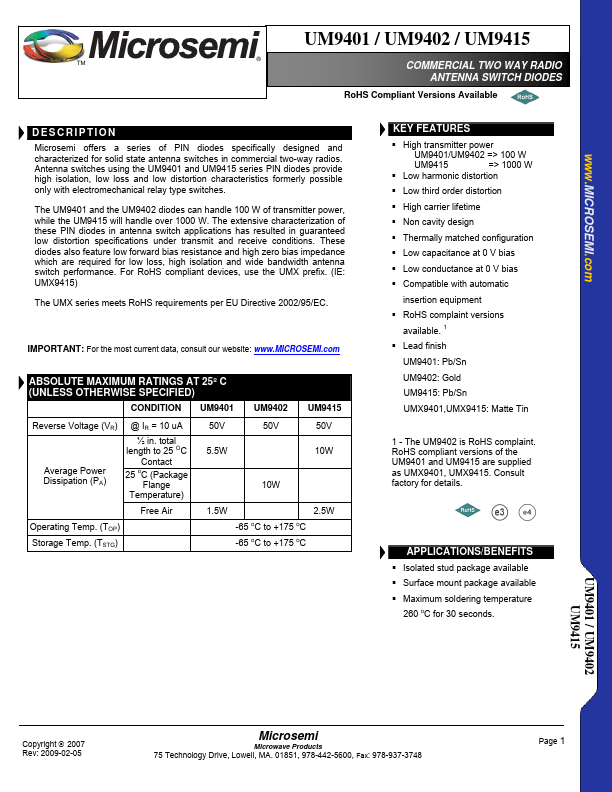
www.MICROSEMI.com UM9401 / UM9402 / UM9415 ® TM COMMERCIAL TWO WAY RADIO ANTENNA SWITCH DIODES RoHS Compliant Versions Available DESCRIPTION Microsemi offers a series of PIN diodes specifically designed and characterized for solid state antenna switches in commercial two-way radios. Antenna switches using the UM9401 and UM9415 series PIN diodes provide high isolation, low loss and low distortion characteristics formerly possible only with electromechanical relay type switches. The UM9401 and the UM9402 diodes can handle 100 W of transmitter power, while the UM9415 will handle over 1000 W. The extensive characterization of these PIN diodes in antenna switch applications has resulted in guaranteed low distortion specifications under transmit and receive conditions.
Published: |