UPG174TA
UPG174TA is L-BAND PA DRIVER AMPLIFIER manufactured by NEC.
DESCRIPTION
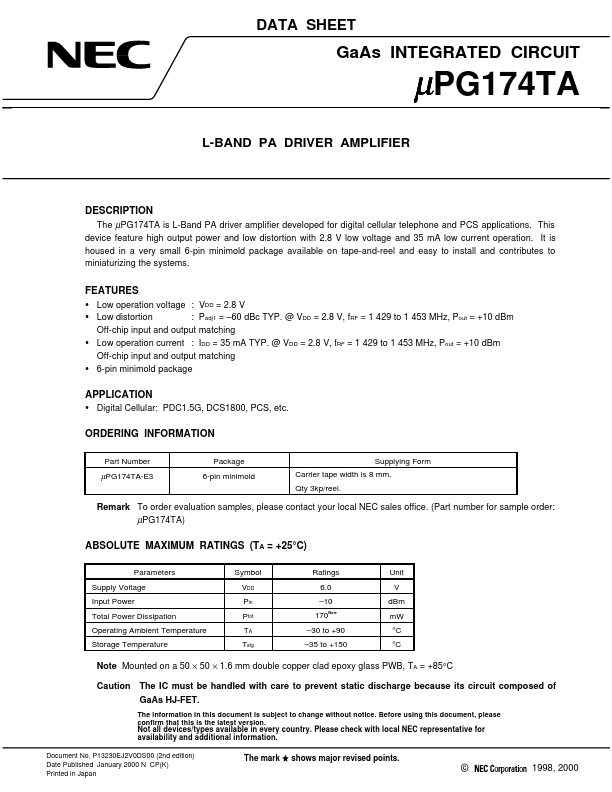
The µPG174TA is L-Band PA driver amplifier developed for digital cellular telephone and PCS applications. This device feature high output power and low distortion with 2.8 V low voltage and 35 m A low current operation. It is housed in a very small 6-pin minimold package available on tape-and-reel and easy to install and contributes to miniaturizing the systems.
FEATURES y Low operation voltage : VDD = 2.8 V : Padj1 =
- 60 d Bc TYP. @ VDD = 2.8 V, f RF = 1 429 to 1 453 MHz, Pout = +10 d Bm y Low distortion Off-chip input and output matching y Low operation current : IDD = 35 m A TYP. @ VDD = 2.8 V, f RF = 1 429 to 1 453 MHz, Pout = +10 d Bm Off-chip input and output matching y 6-pin minimold package
APPLICATION y Digital Cellular: PDC1.5G, DCS1800, PCS, etc.
ORDERING INFORMATION
Part Number Package 6-pin minimold Qty 3kp/reel. Supplying Form Carrier tape width is 8 mm.
µPG174TA-E3
Remark To order evaluation samples, please contact your local NEC sales office. (Part number for sample order: µPG174TA)
ABSOLUTE MAXIMUM RATINGS (TA = +25°C)
Parameters Supply Voltage Input Power Total Power Dissipation Operating Ambient Temperature Storage Temperature Symbol VDD Pin Ptot TA Tstg Ratings 6.0
- 10 170
Note
Unit V d Bm m W °C °C
- 30 to +90
- 35 to +150
Note Mounted on a 50 × 50 × 1.6 mm double copper clad epoxy glass PWB, TA = +85°C Caution The IC must be handled with care to prevent static discharge because its circuit posed of Ga As HJ-FET.
The information in this document is subject to change without notice. Before using this document, please confirm that this is the latest version.
Not all devices/types available in every country. Please check with local NEC representative for availability and additional information.
Document No. P13230EJ2V0DS00 (2nd edition) Date Published January 2000 N CP(K) Printed in Japan
The mark shows major revised points.
©
1998, 2000
µPG174TA
PIN CONNECTION AND INTERNAL BLOCK DIAGRAM
Pin No. Connection GND GND IN VDD1 GND VDD2 &...