

Datasheet4U Logo Datasheet4U.com

74HCT40105 - 4-bit x 16-word FIFO register

Download the 74HCT40105 datasheet PDF. This datasheet also covers the 74HC40105 variant, as both devices belong to the same 4-bit x 16-word fifo register family and are provided as variant models within a single manufacturer datasheet.

General Description

The 74HC40105; 74HCT40105 is a first-in/first-out (FIFO) "elastic" storage register that can store 16 4-bit words.

It can handle input and output data at different shifting rates.

This feature makes it particularly useful as a buffer between asynchronous systems.

Key Features

  • Independent asynchronous inputs and outputs.
  • Expandable in either direction.
  • Reset capability.
  • Status indicators on inputs and outputs.
  • 3-state outputs.
  • Input levels:.
  • For 74HC40105: CMOS level.
  • For 74HCT40105: TTL level.
  • 3-state outputs.
  • Complies with JEDEC standard JESD7A.
  • ESD protection:.
  • HBM JESD22-A114F exceeds 2 000 V.
  • MM JESD22-A115-A exceeds 200 V.
  • Multiple package options.
  • Specified from 40 C to +85 C and fro.

📥 Download Datasheet

Note: The manufacturer provides a single datasheet file (74HC40105-NXP.pdf) that lists specifications for multiple related part numbers.

Full PDF Text Transcription for 74HCT40105 (Reference)

Note: Below is a high-fidelity text extraction (approx. 800 characters) for 74HCT40105. For precise diagrams, and layout, please refer to the original PDF.

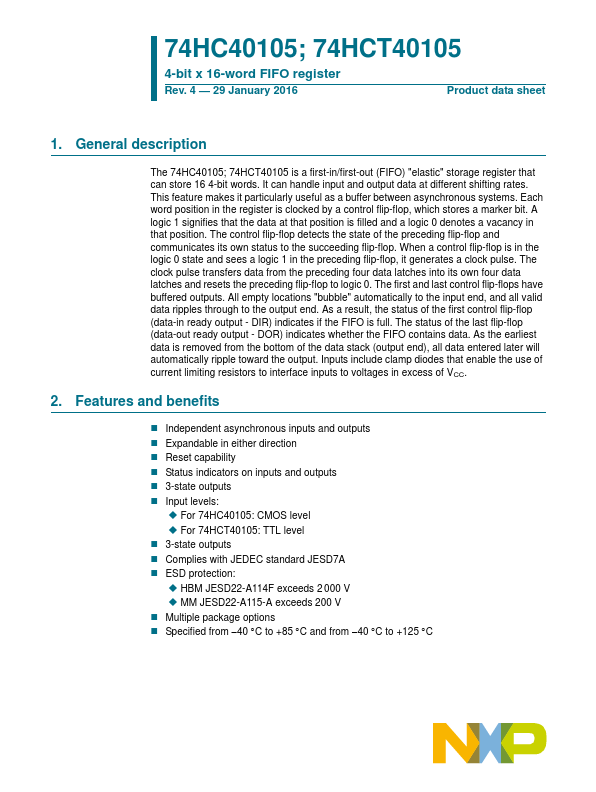
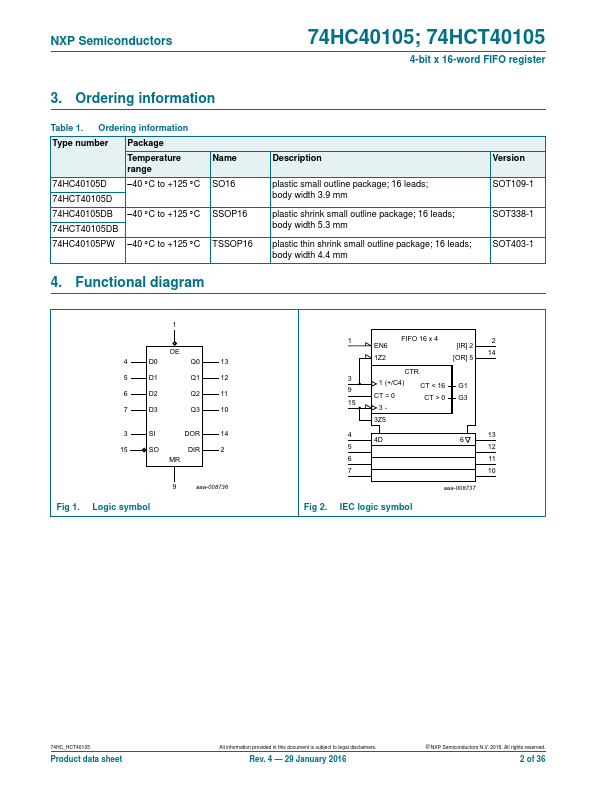
74HC40105; 74HCT40105 4-bit x 16-word FIFO register Rev. 4 — 29 January 2016 Product data sheet 1. General description The 74HC40105; 74HCT40105 is a first-in/first-out (...

View more extracted text
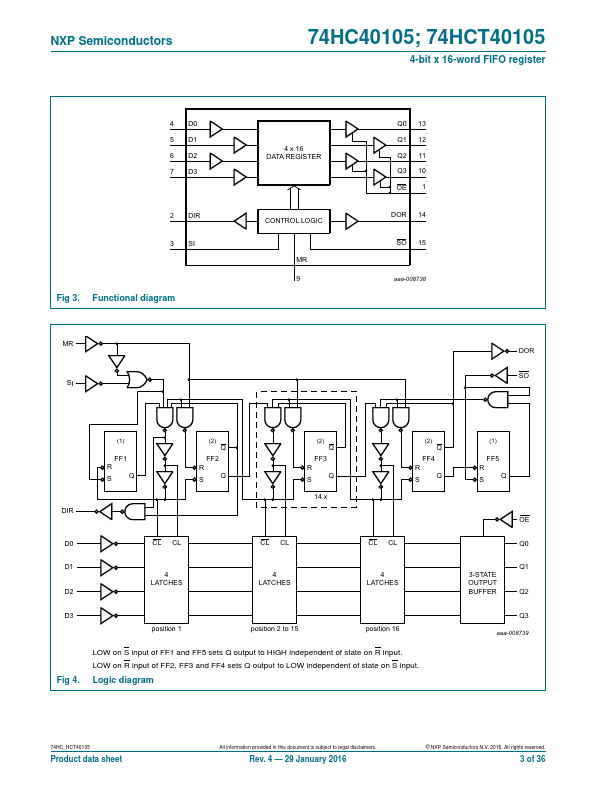
eneral description The 74HC40105; 74HCT40105 is a first-in/first-out (FIFO) "elastic" storage register that can store 16 4-bit words. It can handle input and output data at different shifting rates. This feature makes it particularly useful as a buffer between asynchronous systems. Each word position in the register is clocked by a control flip-flop, which stores a marker bit. A logic 1 signifies that the data at that position is filled and a logic 0 denotes a vacancy in that position. The control flip-flop detects the state of the preceding flip-flop and communicates its own status to the succeeding flip-flop.