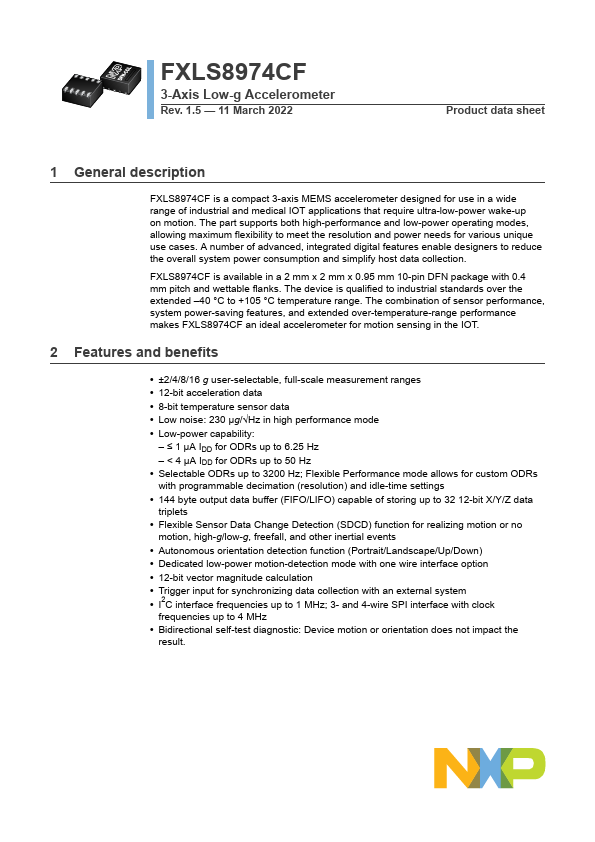
FXLS8974CF
FXLS8974CF is 3-Axis Low-g Accelerometer manufactured by NXP Semiconductors.
description
FXLS8974CF is a pact 3-axis MEMS accelerometer designed for use in a wide range of industrial and medical IOT applications that require ultra-low-power wake-up on motion. The part supports both high-performance and low-power operating modes, allowing maximum flexibility to meet the resolution and power needs for various unique use cases. A number of advanced, integrated digital features enable designers to reduce the overall system power consumption and simplify host data collection.
FXLS8974CF is available in a 2 mm x 2 mm x 0.95 mm 10-pin DFN package with 0.4 mm pitch and wettable flanks. The device is qualified to industrial standards over the extended
- 40 °C to +105 °C temperature range. The bination of sensor performance, system power-saving features
, and extended over-temperature-range performance makes FXLS8974CF an ideal accelerometer for motion sensing in the IOT.
2 Features and benefits
- ±2/4/8/16 g user-selectable, full-scale measurement ranges
- 12-bit acceleration data
- 8-bit temperature sensor data
- Low noise: 230 µg/√Hz in high performance mode
- Low-power capability:
- ≤ 1 μA IDD for ODRs up to 6.25 Hz
- < 4 µA IDD for ODRs up to 50 Hz
- Selectable ODRs up to 3200 Hz; Flexible Performance mode allows for custom ODRs with programmable decimation (resolution) and idle-time settings
- 144 byte output data buffer (FIFO/LIFO) capable of storing up to 32 12-bit X/Y/Z data triplets
- Flexible Sensor Data Change Detection (SDCD) function for realizing motion or no motion, high-g/low-g, freefall, and other inertial events
- Autonomous orientation detection function (Portrait/Landscape/Up/Down)
- Dedicated low-power motion-detection mode with one wire interface option
- 12-bit vector magnitude calculation
- Trigger input for synchronizing data collection with an external system
- I2C interface frequencies up to 1 MHz; 3- and 4-wire SPI interface with clock frequencies up to 4 MHz
- Bidirectional self-test diagnostic: Device motion or...