

Datasheet4U Logo Datasheet4U.com

HTSICH48 - HITAG S transponder

Download the HTSICH48 datasheet PDF. This datasheet also covers the HTSICH56 variant, as both devices belong to the same hitag s transponder family and are provided as variant models within a single manufacturer datasheet.

General Description

The HITAG product line is well known and established in the contactless identification market.

Due to the open marketing strategy of NXP Semiconductors there are various manufacturers well established for both the transponders / cards as well as the Read/Write Devices.

Key Features

  • 2.1 Features.
  • Integrated Circuit for Contactless Identification Transponders and Cards.
  • Integrated resonance capacitor of 210 pF with 5 % tolerance over full production.
  • Frequency range 100 kHz to 150 kHz. 2.2 Protocol.
  • Modulation Read/Write Device  Transponder: 100 % ASK and Binary Pulse Length Coding.
  • Modulation Transponder  Read/Write Device: Strong ASK modulation with Anticollision, Manchester and Bi-phase Coding.
  • Fast Anticollision Protocol for inventory tra.

📥 Download Datasheet

Note: The manufacturer provides a single datasheet file (HTSICH56-NXP.pdf) that lists specifications for multiple related part numbers.

Full PDF Text Transcription (Reference)

The following content is an automatically extracted verbatim text from the original manufacturer datasheet and is provided for reference purposes only.

View original datasheet text
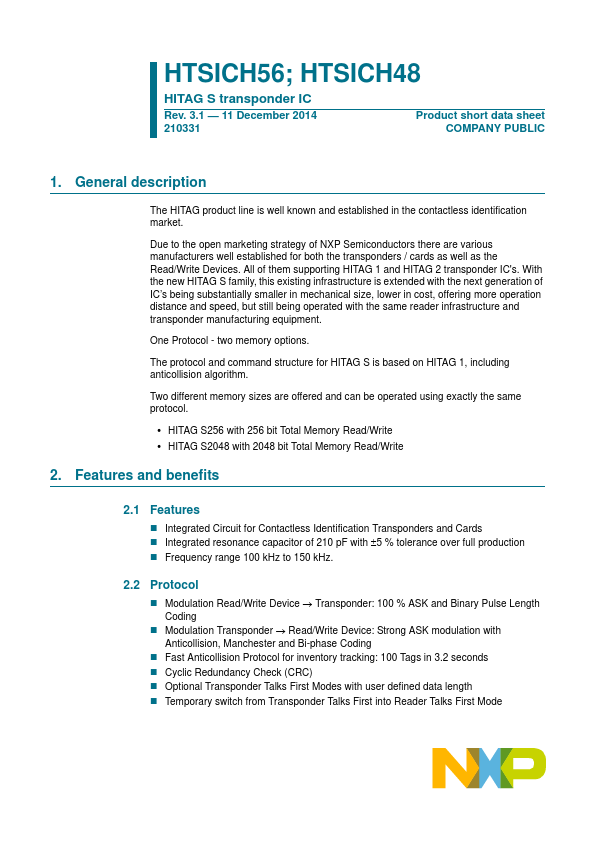
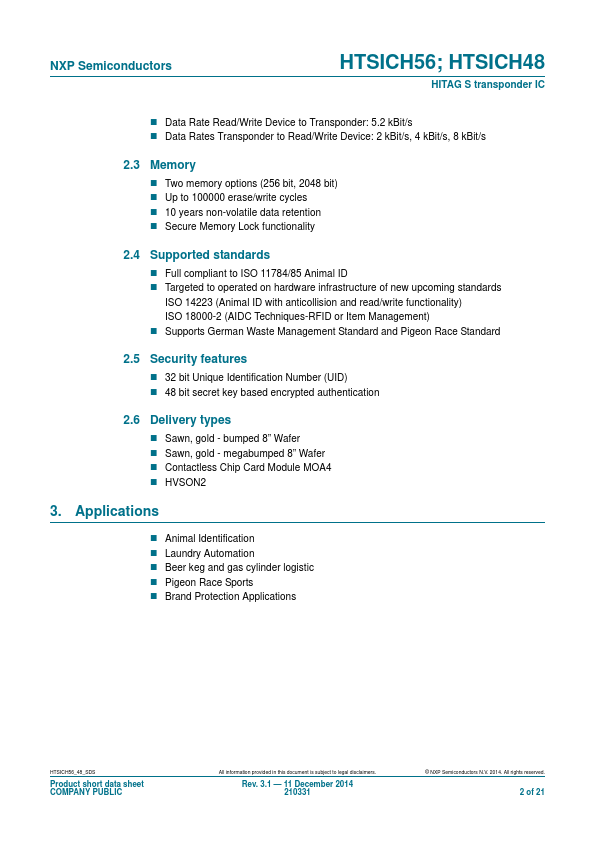
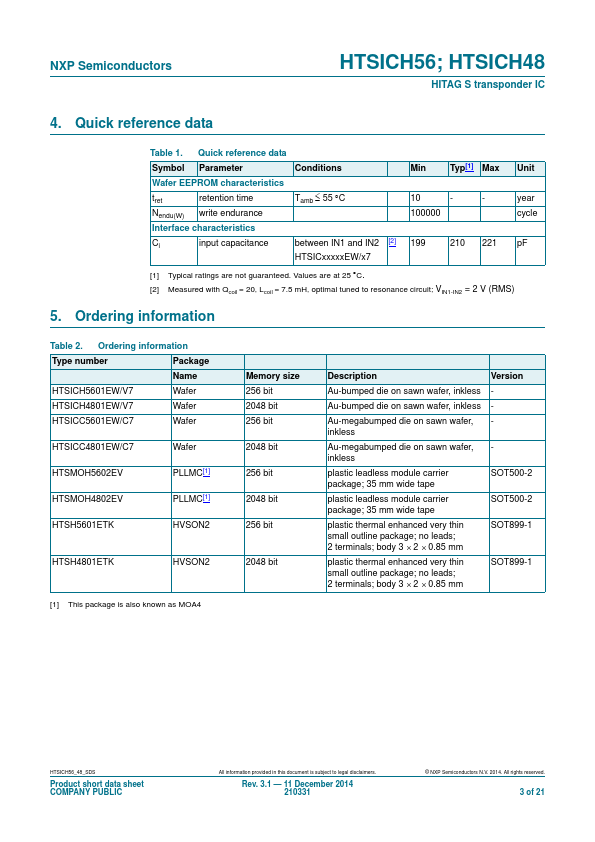
HTSICH56; HTSICH48 HITAG S transponder IC Rev. 3.1 — 11 December 2014 210331 Product short data sheet COMPANY PUBLIC 1. General description The HITAG product line is well known and established in the contactless identification market. Due to the open marketing strategy of NXP Semiconductors there are various manufacturers well established for both the transponders / cards as well as the Read/Write Devices. All of them supporting HITAG 1 and HITAG 2 transponder IC's. With the new HITAG S family, this existing infrastructure is extended with the next generation of IC’s being substantially smaller in mechanical size, lower in cost, offering more operation distance and speed, but still being operated with the same reader infrastructure and transponder manufacturing equipment.