

Datasheet4U Logo Datasheet4U.com

DS26C32AM - Quad Differential Line Receiver

Download the DS26C32AM datasheet PDF. This datasheet also covers the DS26C32AT variant, as both devices belong to the same quad differential line receiver family and are provided as variant models within a single manufacturer datasheet.

Description

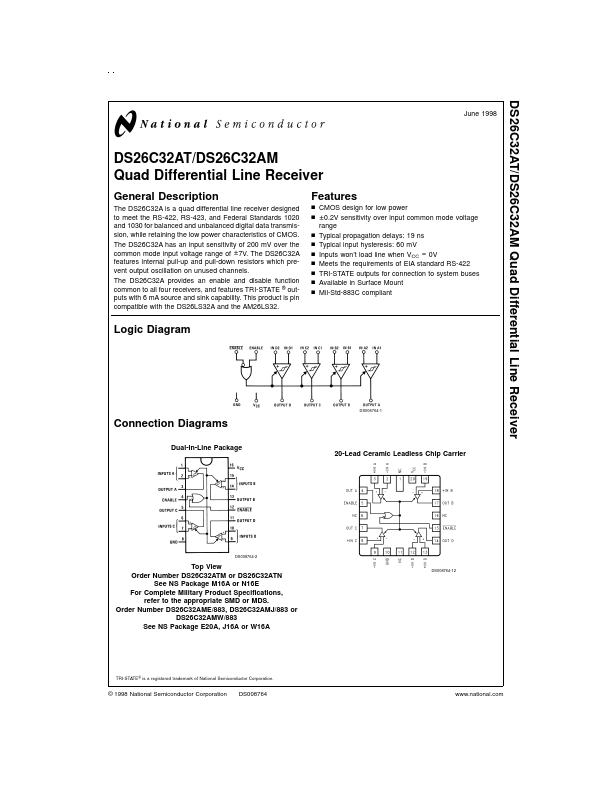
The DS26C32A is a quad differential line receiver designed to meet the RS-422, RS-423, and Federal Standards 1020 and 1030 for balanced and unbalanced digital data transmission, while retaining the low power characteristics of CMOS.

Features

  • internal pull-up and pull-down resistors which prevent output oscillation on unused channels. The DS26C32A provides an enable and disable function common to all four receivers, and features TRI-STATE ® outputs with 6 mA source and sink capability. This product is pin compatible with the DS26LS32A and the AM26LS32. Features n CMOS design for low power n ±0.2V sensitivity over input common mode voltage range n Typical propagation delays: 19 ns n Typical input hysteresis: 60 mV n Inputs won’t load.

📥 Download Datasheet

Note: The manufacturer provides a single datasheet file (DS26C32AT_NationalSemiconductor.pdf) that lists specifications for multiple related part numbers.

Full PDF Text Transcription

Click to expand full text
DS26C32AT/DS26C32AM Quad Differential Line Receiver June 1998 DS26C32AT/DS26C32AM Quad Differential Line Receiver General Description The DS26C32A is a quad differential line receiver designed to meet the RS-422, RS-423, and Federal Standards 1020 and 1030 for balanced and unbalanced digital data transmission, while retaining the low power characteristics of CMOS. The DS26C32A has an input sensitivity of 200 mV over the common mode input voltage range of ±7V. The DS26C32A features internal pull-up and pull-down resistors which prevent output oscillation on unused channels. The DS26C32A provides an enable and disable function common to all four receivers, and features TRI-STATE ® outputs with 6 mA source and sink capability.
Published: |