

Datasheet4U Logo Datasheet4U.com

FAN2002 - High-Efficiency Step-Down DC-DC Converter

Download the FAN2002 datasheet PDF. This datasheet also covers the FAN2001 variant, as both devices belong to the same high-efficiency step-down dc-dc converter family and are provided as variant models within a single manufacturer datasheet.

Description

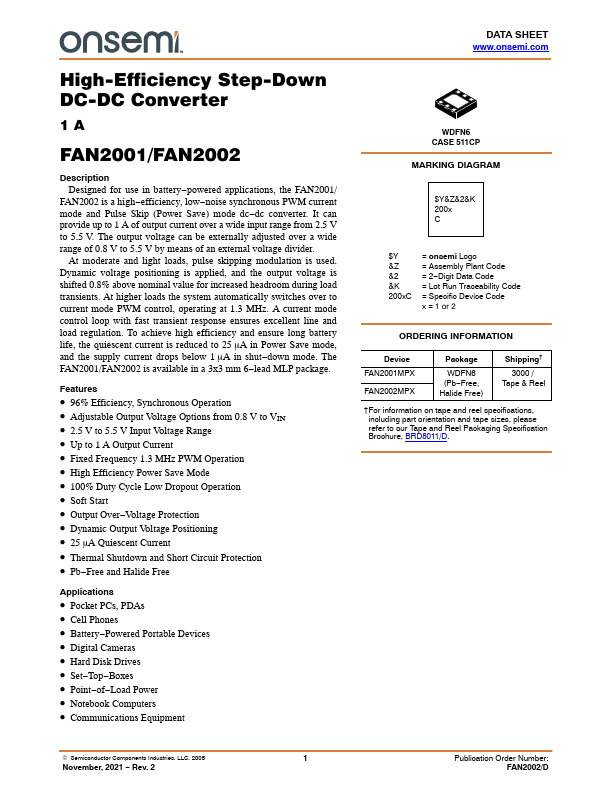
Designed for use in battery powered applications, the FAN2001/ FAN2002 is a high efficiency, low noise synchronous PWM current mode and Pulse Skip (Power Save) mode dc

dc converter.

Features

  • 96% Efficiency, Synchronous Operation.
  • Adjustable Output Voltage Options from 0.8 V to VIN.
  • 2.5 V to 5.5 V Input Voltage Range.
  • Up to 1 A Output Current.
  • Fixed Frequency 1.3 MHz PWM Operation.
  • High Efficiency Power Save Mode.
  • 100% Duty Cycle Low Dropout Operation.
  • Soft Start.
  • Output Over.
  • Voltage Protection.
  • Dynamic Output Voltage Positioning.
  • 25 mA Quiescent Current.
  • Thermal Shutd.

📥 Download Datasheet

Note: The manufacturer provides a single datasheet file (FAN2001-ONSemiconductor.pdf) that lists specifications for multiple related part numbers.

Datasheet Details

Part number FAN2002
Manufacturer onsemi
File Size 439.98 KB
Description High-Efficiency Step-Down DC-DC Converter
Datasheet download datasheet FAN2002 Datasheet

Full PDF Text Transcription (Reference)

The following content is an automatically extracted verbatim text from the original manufacturer datasheet and is provided for reference purposes only.

View original datasheet text
High-Efficiency Step-Down DC-DC Converter 1A FAN2001/FAN2002 Description Designed for use in battery−powered applications, the FAN2001/ FAN2002 is a high−efficiency, low−noise synchronous PWM current mode and Pulse Skip (Power Save) mode dc−dc converter. It can provide up to 1 A of output current over a wide input range from 2.5 V to 5.5 V. The output voltage can be externally adjusted over a wide range of 0.8 V to 5.5 V by means of an external voltage divider. At moderate and light loads, pulse skipping modulation is used. Dynamic voltage positioning is applied, and the output voltage is shifted 0.8% above nominal value for increased headroom during load transients. At higher loads the system automatically switches over to current mode PWM control, operating at 1.3 MHz.
Published: |