

Datasheet4U Logo Datasheet4U.com

RT7236 - Synchronous Step-Down Converter

Download the RT7236 datasheet PDF. This datasheet also covers the RT7235 variant, as both devices belong to the same synchronous step-down converter family and are provided as variant models within a single manufacturer datasheet.

Description

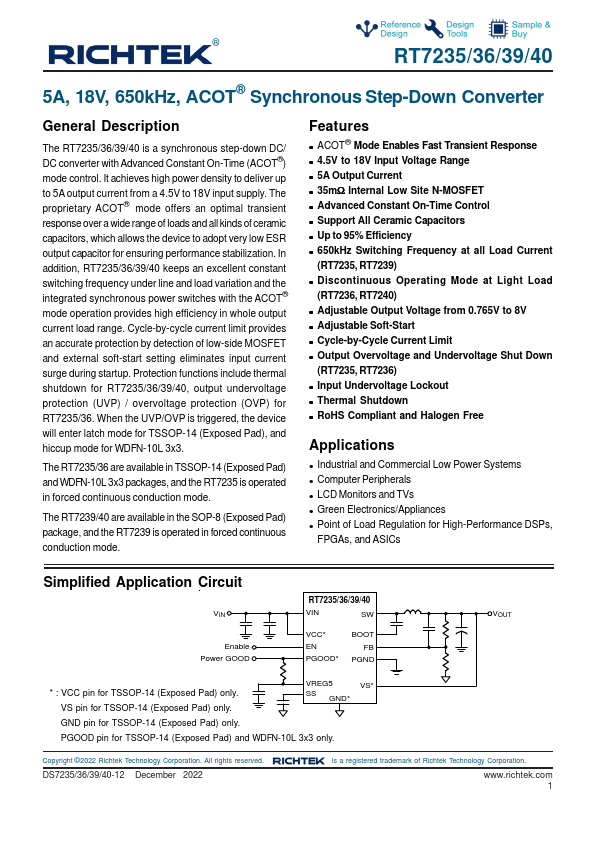
The RT7235/36/39/40 is a synchronous step-down DC/ DC converter with Advanced Constant On-Time (ACOT®) mode control.

It achieves high power density to deliver up to 5A output current from a 4.5V to 18V input supply.

Features

  • ACOT® Mode Enables Fast Transient Response.
  • 4.5V to 18V Input Voltage Range.
  • 5A Output Current.
  • 35mΩ Internal Low Site N-MOSFET.
  • Advanced Constant On-Time Control.
  • Support All Ceramic Capacitors.
  • Up to 95% Efficiency.
  • 650kHz Switching Frequency at all Load Current (RT7235, RT7239).
  • Discontinuous Operating Mode at Light Load (RT7236, RT7240).
  • Adjustable Output Voltage from 0.765V to 8V.
  • Adjustable Soft-Start.
  • Cycle-by-Cycle Current Limi.

📥 Download Datasheet

Note: The manufacturer provides a single datasheet file (RT7235_Richtek.pdf) that lists specifications for multiple related part numbers.

Datasheet Details

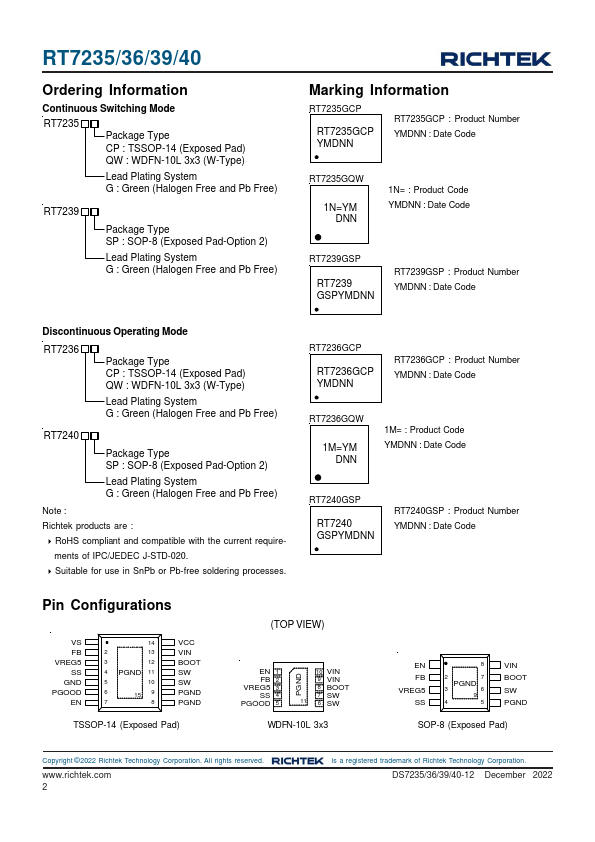
Part number RT7236
Manufacturer Richtek
File Size 342.59 KB
Description Synchronous Step-Down Converter
Datasheet download datasheet RT7236 Datasheet

Full PDF Text Transcription (Reference)

The following content is an automatically extracted verbatim text from the original manufacturer datasheet and is provided for reference purposes only.

View original datasheet text
Reference Design Sample & Design Tools Buy ® RT7235/36/39/40 5A, 18V, 650kHz, ACOT® Synchronous Step-Down Converter General Description The RT7235/36/39/40 is a synchronous step-down DC/ DC converter with Advanced Constant On-Time (ACOT®) mode control. It achieves high power density to deliver up to 5A output current from a 4.5V to 18V input supply. The proprietary ACOT® mode offers an optimal transient response over a wide range of loads and all kinds of ceramic capacitors, which allows the device to adopt very low ESR output capacitor for ensuring performance stabilization.
Published: |