

Datasheet4U Logo Datasheet4U.com

BD00KA5WF-E2 - 500mA Variable/Fixed Output LDO Regulators

This page provides the datasheet information for the BD00KA5WF-E2, a member of the BD10KA-5WFP 500mA Variable/Fixed Output LDO Regulators family.

Datasheet Summary

Description

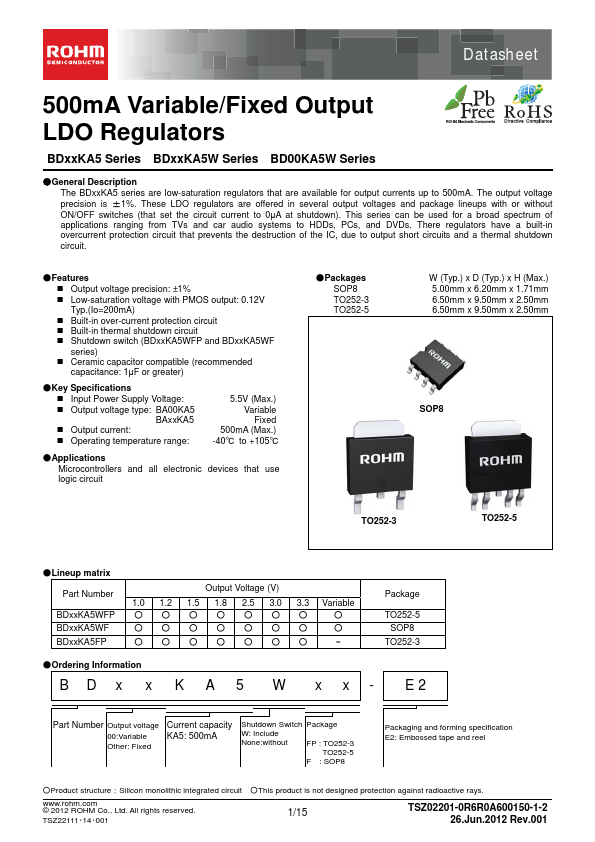
The BDxxKA5 series are low-saturation regulators that are available for output currents up to 500mA.

The output voltage precision is ±1%.

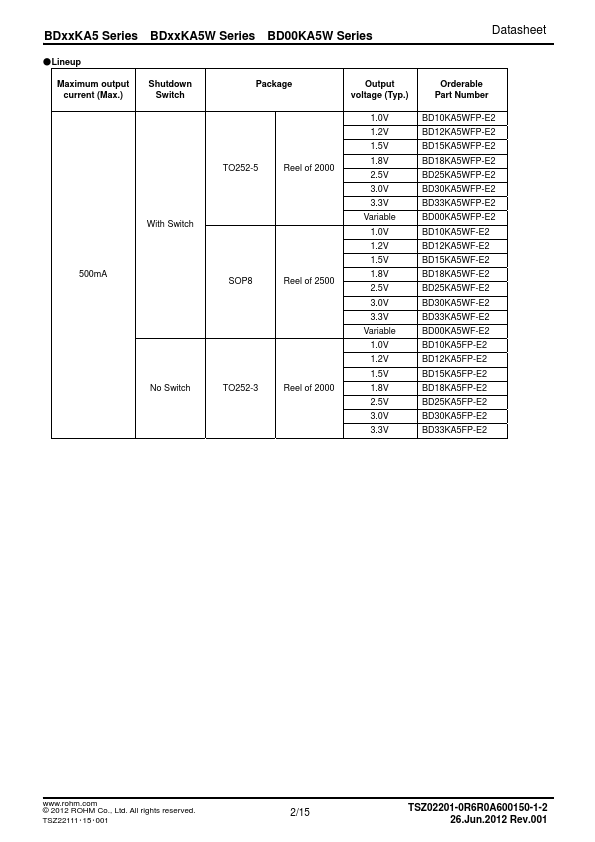
These LDO regulators are offered in several output voltages and package lineups with or without ON/OFF switches (that set the circuit current to 0μA at shutdown).

Features

  • br>.
  • Output voltage precision: ±1%.
  • Low-saturation voltage with PMOS output: 0.12V Typ. (Io=200mA).
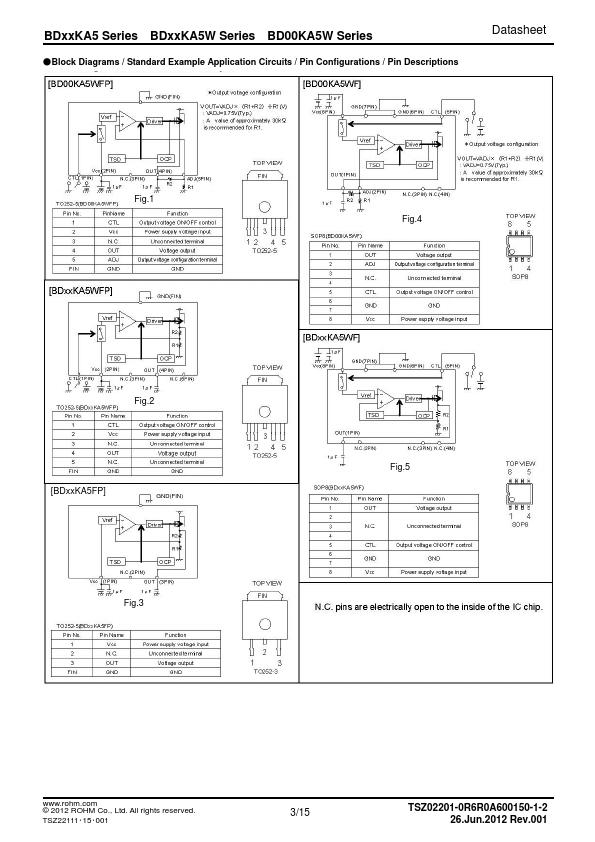
  • Built-in over-current protection circuit.
  • Built-in thermal shutdown circuit.
  • Shutdown switch (BDxxKA5WFP and BDxxKA5WF series).
  • Ceramic capacitor compatible (recommended capacitance: 1μF or greater).
  • Key Specifications.
  • Input Power Supply Voltage:.
  • Output voltage type: BA00KA5 BAxxKA5.
  • Output current:.
  • Operatin.

📥 Download Datasheet

Datasheet preview – BD00KA5WF-E2

Datasheet Details

Part number BD00KA5WF-E2
Manufacturer ROHM
File Size 657.49 KB
Description 500mA Variable/Fixed Output LDO Regulators
Datasheet download datasheet BD00KA5WF-E2 Datasheet
Additional preview pages of the BD00KA5WF-E2 datasheet.
Other Datasheets by Rohm

Full PDF Text Transcription

Click to expand full text
Datasheet 500mA Variable/Fixed Output LDO Regulators BDxxKA5 Series BDxxKA5W Series BD00KA5W Series ●General Description The BDxxKA5 series are low-saturation regulators that are available for output currents up to 500mA. The output voltage precision is ±1%. These LDO regulators are offered in several output voltages and package lineups with or without ON/OFF switches (that set the circuit current to 0μA at shutdown). This series can be used for a broad spectrum of applications ranging from TVs and car audio systems to HDDs, PCs, and DVDs. There regulators have a built-in overcurrent protection circuit that prevents the destruction of the IC, due to output short circuits and a thermal shutdown circuit.
Published: |