

Datasheet4U Logo Datasheet4U.com

BL0510 - General Infrared Ray Remote Control Receiver

Download the BL0510 datasheet PDF. This datasheet also covers the BL0509 variant, as both devices belong to the same general infrared ray remote control receiver family and are provided as variant models within a single manufacturer datasheet.

Description

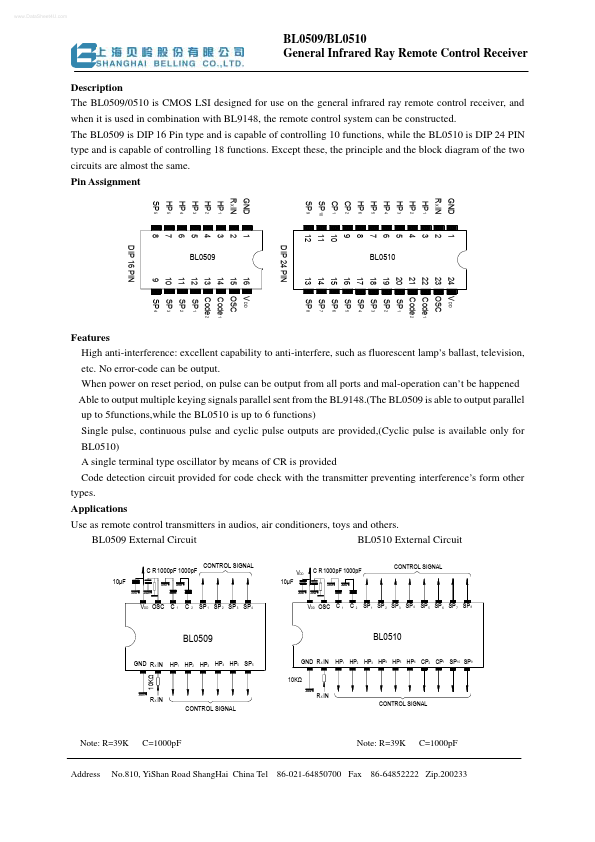
The BL0509/0510 is CMOS LSI designed for use on the general infrared ray remote control receiver, and when it is used in combination with BL9148, the remote control system can be constructed.

Features

  • ¡¤ High anti-interference: excellent capability to anti-interfere, such as fluorescent lamp’s ballast, television, etc. No error-code can be output. ¡¤ When power on reset period, on pulse can be output from all ports and mal-operation can’t be happened ¡¤ Able to output multiple keying signals parallel sent from the BL9148.(The BL0509 is able to output parallel up to 5functions,while the BL0510 is up to 6 functions) ¡¤ Single pulse, continuous pulse and cyclic pulse outputs are provided,(Cyclic.

📥 Download Datasheet

Note: The manufacturer provides a single datasheet file (BL0509_SHANGHAIBELLING.pdf) that lists specifications for multiple related part numbers.

Datasheet Details

Part number BL0510
Manufacturer SHANGHAI BELLING
File Size 79.81 KB
Description General Infrared Ray Remote Control Receiver
Datasheet download datasheet BL0510 Datasheet

Full PDF Text Transcription (Reference)

The following content is an automatically extracted verbatim text from the original manufacturer datasheet and is provided for reference purposes only.

View original datasheet text
www.DataSheet4U.com BL0509/BL0510 General Infrared Ray Remote Control Receiver Description The BL0509/0510 is CMOS LSI designed for use on the general infrared ray remote control receiver, and when it is used in combination with BL9148, the remote control system can be constructed. The BL0509 is DIP 16 Pin type and is capable of controlling 10 functions, while the BL0510 is DIP 24 PIN type and is capable of controlling 18 functions. Except these, the principle and the block diagram of the two circuits are almost the same.
Published: |