

Datasheet4U Logo Datasheet4U.com

LMV358L - Low-power general-purpose operational amplifiers

This page provides the datasheet information for the LMV358L, a member of the LMV321L Low-power general-purpose operational amplifiers family.

Description

The LMV321L, LMV358L, and LMV324L are single, dual, and quad operational amplifiers with rail-to-rail output capabilities.

They are specifically designed to operate at low voltages (2.7 V to 5 V) with enhanced performances compared to the industry standard LM3xx series.

Features

  • Low-power consumption: 250 µA max at 5 V.
  • Low offset voltage: 7 mV max at 25 °C.
  • Industrial temperature range: -40 °C to +125 °C.
  • Low supply voltage: 2.7 V - 5.5 V.
  • Gain bandwidth product: 1.3 MHz.
  • Tiny packages December 2014 This is information on a product in full production. DocID023066 Rev 3 1/21 www. st. com Contents Contents LMV321L, LMV358L, LMV324L 1 Package pin connections.

📥 Download Datasheet

Datasheet preview – LMV358L

Datasheet Details

Part number LMV358L
Manufacturer STMicroelectronics
File Size 635.42 KB
Description Low-power general-purpose operational amplifiers
Datasheet download datasheet LMV358L Datasheet
Additional preview pages of the LMV358L datasheet.
Other Datasheets by STMicroelectronics

Full PDF Text Transcription

Click to expand full text
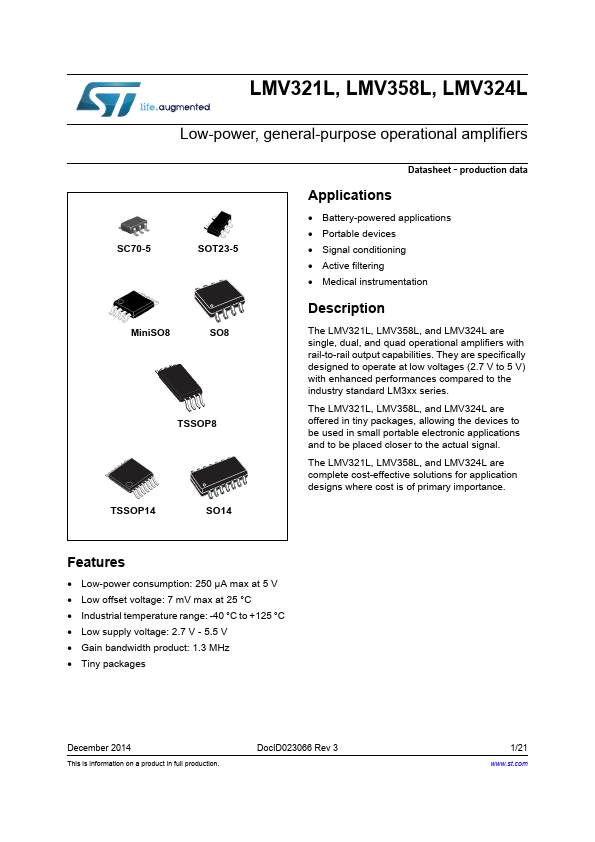
LMV321L, LMV358L, LMV324L Low-power, general-purpose operational amplifiers SC70-5 SOT23-5 MiniSO8 SO8 TSSOP8 TSSOP14 SO14 Datasheet - production data Applications • Battery-powered applications • Portable devices • Signal conditioning • Active filtering • Medical instrumentation Description The LMV321L, LMV358L, and LMV324L are single, dual, and quad operational amplifiers with rail-to-rail output capabilities. They are specifically designed to operate at low voltages (2.7 V to 5 V) with enhanced performances compared to the industry standard LM3xx series. The LMV321L, LMV358L, and LMV324L are offered in tiny packages, allowing the devices to be used in small portable electronic applications and to be placed closer to the actual signal.
Published: |