RT2901H
RT2901H is RobuST high-temperature low-power quad voltage comparators manufactured by STMicroelectronics.
Robu ST high-temperature low-power quad voltage parators
- production data
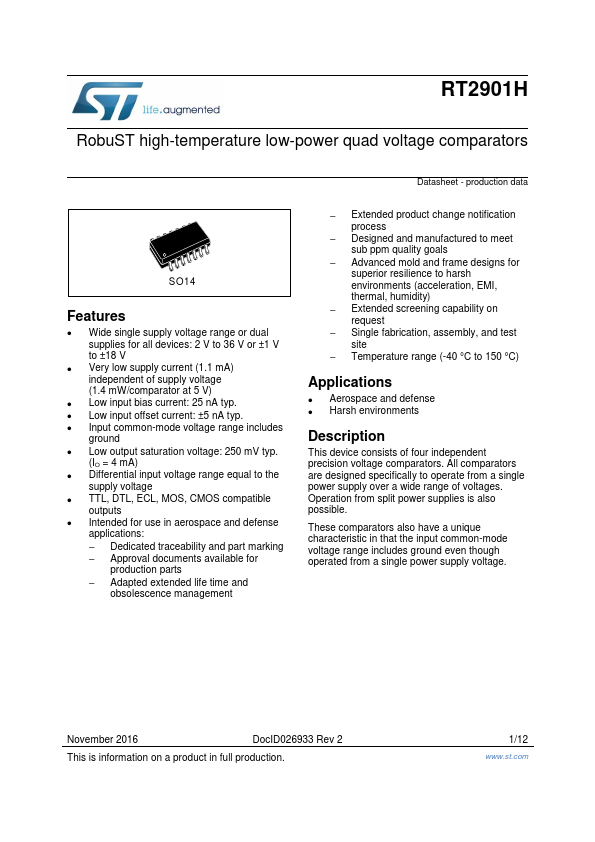
SO14
Features
Wide single supply voltage range or dual supplies for all devices: 2 V to 36 V or ±1 V to ±18 V Very low supply current (1.1 m A) independent of supply voltage (1.4 m W/parator at 5 V) Low input bias current: 25 n A typ. Low input offset current: ±5 n A typ. Input mon-mode voltage range includes ground Low output saturation voltage: 250 m V typ. (IO = 4 m A) Differential input voltage range equal to the supply voltage TTL, DTL, ECL, MOS, CMOS patible outputs Intended for use in aerospace and defense applications:
Dedicated traceability and part marking Approval documents available for production parts Adapted extended life time and obsolescence management
Extended product change notification process Designed and manufactured to meet sub ppm quality goals Advanced mold and frame designs for superior resilience to harsh environments (acceleration, EMI, thermal, humidity) Extended screening capability on request Single fabrication, assembly, and test site Temperature range (-40 °C to 150 °C)
Applications
Aerospace and defense Harsh environments
Description
This device consists of four independent precision voltage parators. All parators are designed specifically to operate from a single power supply over a wide range of voltages. Operation from split power supplies is also possible.
These parators also have a unique characteristic in that the input mon-mode voltage range includes ground even though operated from a single power supply voltage.
November 2016
Doc ID026933 Rev 2
This is information on a product in full production.
1/12
.st.
Contents
Contents
1 Schematic diagram.......................................................................... 3 2 Package pin connections................................................................ 4 3...