Datasheet4U Logo Datasheet4U.com

SDED5-002G-NCY - mDOC H3 Software

This page provides the datasheet information for the SDED5-002G-NCY, a member of the SDED7-256M-N9Y mDOC H3 Software family.

Datasheet Summary

Description

Preliminary version RSRVD balls left floating changed from a recommendation to a requirement Demux (Standard) I/F Ball H9 changed from RSRVD to VSS Ballout change Some NC balls removed, resulting in 115 balls for all products Ball H2 changed from DPD to A0 Details on internal pull up and p

Features

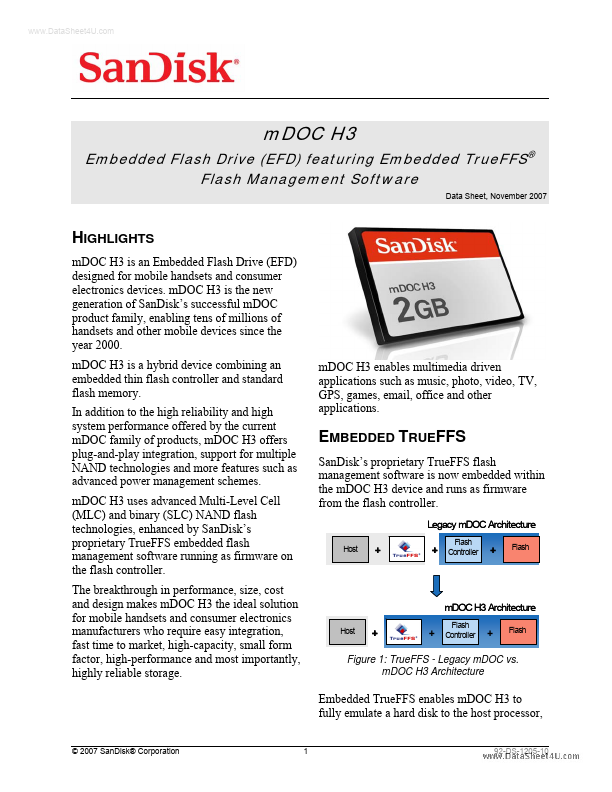
  • such as advanced power management schemes. mDOC H3 uses advanced Multi-Level Cell (MLC) and binary (SLC) NAND flash technologies, enhanced by SanDisk’s proprietary TrueFFS embedded flash management software running as firmware on the flash controller. The breakthrough in performance, size, cost and design makes mDOC H3 the ideal solution for mobile handsets and consumer electronics manufacturers who require easy integration, fast time to market, high-capacity, small form factor, high-performance.

📥 Download Datasheet

Datasheet preview – SDED5-002G-NCY

Datasheet Details

Part number SDED5-002G-NCY
Manufacturer Sandisk
File Size 1.74 MB
Description mDOC H3 Software
Datasheet download datasheet SDED5-002G-NCY Datasheet
Additional preview pages of the SDED5-002G-NCY datasheet.
Other Datasheets by Sandisk

Full PDF Text Transcription

Click to expand full text
www.DataSheet4U.com mDOC H3 Embedded Flash Drive (EFD) featuring Embedded TrueFFS® Flash Management Software Data Sheet, November 2007 HIGHLIGHTS mDOC H3 is an Embedded Flash Drive (EFD) designed for mobile handsets and consumer electronics devices. mDOC H3 is the new generation of SanDisk’s successful mDOC product family, enabling tens of millions of handsets and other mobile devices since the year 2000. mDOC H3 is a hybrid device combining an embedded thin flash controller and standard flash memory. In addition to the high reliability and high system performance offered by the current mDOC family of products, mDOC H3 offers plug-and-play integration, support for multiple NAND technologies and more features such as advanced power management schemes.
Published: |