





Datasheet4U Logo Datasheet4U.com

MUR860 Datasheet Ultra Fast Recovery Diodes

Manufacturer: Sirectifier

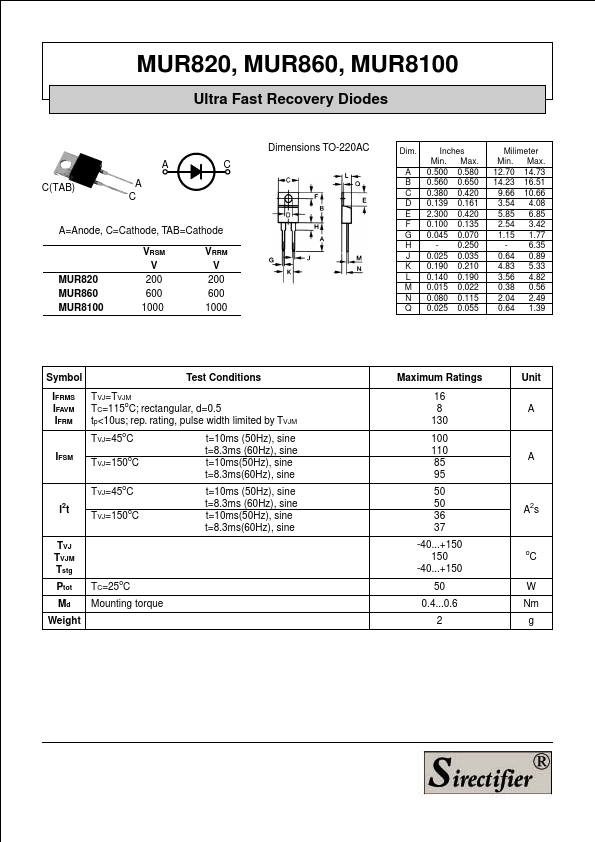
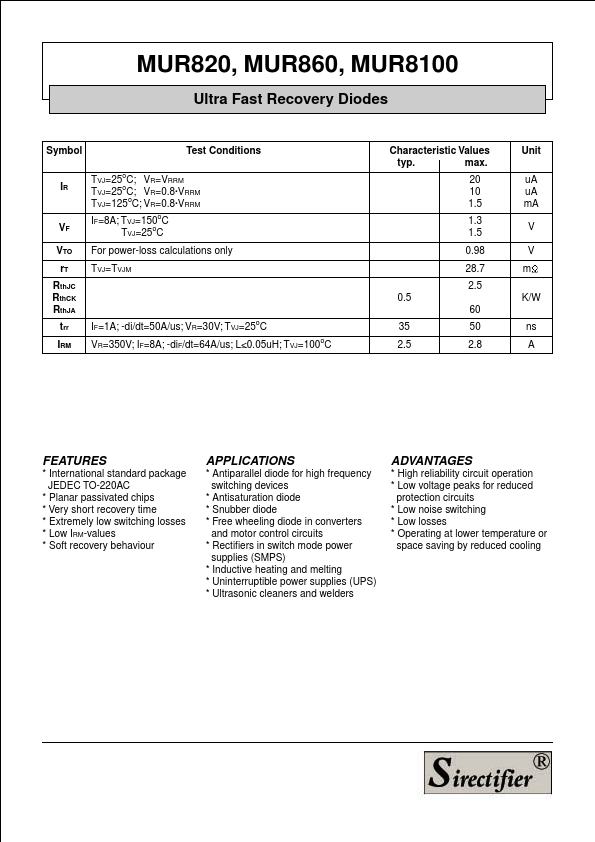
Overview: MUR820, MUR860, MUR8100 Ultra Fast Recovery Diodes Dimensions TO-220AC A C(TAB) A C C Dim. A B C D E F G H J K L M N Q A=Anode, C=Cathode, TAB=Cathode VRSM V 200 600 1000 VRRM V 200 600 1000 MUR820 MUR860 MUR8100 Inches Min. Max. 0.500 0.580 0.560 0.650 0.380 0.420 0.139 0.161 2.300 0.420 0.100 0.135 0.045 0.070 0.250 0.025 0.035 0.190 0.210 0.140 0.190 0.015 0.022 0.080 0.115 0.025 0.055 Milimeter Min. Max. 12.70 14.73 14.23 16.51 9.66 10.66 3.54 4.08 5.85 6.85 2.54 3.42 1.15 1.77 6.35 0.64 0.89 4.83 5.33 3.56 4.82 0.38 0.56 2.04 2.49 0.64 1.39 Symbol IFRMS IFAVM IFRM Test Conditions TVJ=TVJM TC=115oC; rectangular, d=0.5 tp<10us; rep. rating, pulse width limited by TVJM TVJ=45oC t=10ms (50Hz), sine t=8.3ms (60Hz), sine t=10ms(50Hz), sine t=8.3ms(60Hz), sine t=10ms (50Hz), sine t=8.3ms (60Hz), sine t=10ms(50Hz), sine t=8.3ms(60Hz), sine Maximum Ratings 16 8 130 100 110 85 95 50 50 36 37 -40...+150 150 -40...+150 Unit A IFSM TVJ=150oC TVJ=45oC A I2t TVJ=150oC A2s TVJ TVJM Tstg Ptot Md Weight TC=25oC Mounting torque o C 50 0.4...0.6 2 W Nm g MUR820, MUR860, MUR8100 Ultra Fast Recovery Diodes Symbol Test Conditions TVJ=25oC; VR=VRRM TVJ=25oC; VR=0.8.VRRM TVJ=125oC; VR=0.8.VRRM IF=8A; TVJ=150oC TVJ=25oC For power-loss calculations only TVJ=TVJM Characteristic Values typ. max. 20 10 1.5 1.3 1.5 0.98 28.7 2.5 0.5 60 Unit uA uA mA V V m K/W IR VF VTO rT RthJC RthCK RthJA trr IRM IF=1A; -di/dt=50A/us; VR=30V; TVJ=25oC _ VR=350V; IF=8A; -diF/dt=64A/us; L<0.05uH; TVJ=100 C o 35 2.5 50 2.

Download the MUR860 datasheet PDF. This datasheet also includes the MUR820 variant, as both parts are published together in a single manufacturer document.

Datasheet Details

Part number MUR860
Manufacturer Sirectifier
File Size 130.34 KB
Description Ultra Fast Recovery Diodes
Download MUR860 Download (PDF)

Key Features

  • International standard package JEDEC TO-220AC.
  • Planar passivated chips.
  • Very short recovery time.
  • Extremely low switching losses.
  • Low IRM-values.
  • Soft recovery behaviour.